Showing posts with label Pinchas Lapide. Show all posts

Thursday, December 22, 2016

Pope Francis and the BBC

School has closed for the summer holidays and I have time, for the first time in a while, to resume posting!  This post came about after a conversation in my parish a week or so ago.  I was unaware of any of the events that follow which points to just how few ripples this news story generated.

The Pope and the BBC

One of my favourite TV programs has been, and still is, The Golden Girls.  Its waspish humour, deft handling of issues that, for the 1980s at least, were considered somewhat “delicate” for mainstream entertainment, and dealing with the realities of four women of a “certain age” still gives me great laughs.  Estelle Getty’s character  - Sophia Petrillo – was probably the glue that held the show together.  Sophia had a great one liner that would launch her into one of her stories – “picture this … Sicily 1910 …” – and would often earn her the incredulous look of her daughter, Dorothy, Bea Arthur, and the remark, after a suitable pause, “ma, you’re making it up”.  She usually was.  However, what is funny on a sitcom, is not funny when it is presented as historical fact.

In July 2016 Pope Francis visited Poland to join with millions of young people in World Youth Day.  As a part of the journey he made a visit to the former death camp at Auschwitz-Birkenau on 29 July. Francis followed in the footsteps of John Paul II and Benedict XVI who also stood in what is the largest Jewish cemetery in the world.  And like his predecessors, he stood in silence.

That evening in its regular news broadcast the BBC reported on the pope’s visit.  In language that points to the growing gulf between people of faith, good people of different faith, good people of little or no faith, well-meaning journalists under pressure to produce the seconds of “sound bite” for the editors, the news said quite clearly that the Pope’s silence at Auschwitz reflected the “silence” of the Catholic Church during the Holocaust.  I want to believe the journalist was, as David Alton described in a blog entry, simply lazy and had not done their homework. 

I have not heard the BBC report and have not been able to find it, a point the blogger Catholic Voices made reference to as they re-posted Lord Alton’s blog entry.

Reading the text version of the pope’s visit to Auschwitz I was generally impressed by the level of awareness of Catholic Christian practice, even if the reporter did seem impressed by the pope’s “white robes and skullcap”.

It was this sentence that caused considerable offence:

“Silence was the response of the Catholic Church when Nazi Germany demonised Jewish people and then attempted to eradicate Jews from Europe”

Several generations of gradual historical amnesia and sloppy reporting meant that many people were probably not aware of the import of the journalist’s words.  Certainly there was no worldwide upset.  Reactions, such as that of Anne and Ian Dawson, have been few and far between.

The contentious statement is bald, generalised and historically inaccurate.  It demonstrates a lack of basic knowledge that could have been remedied by some equally basic research work online.  I wholeheartedly agree with Lord Alton.  This is the mark of lazy journalism.

I mention Lord Alton because within twenty-four hours he had written a measured and restrained rebuttal of the BBC’s report, especially when he referred to the comment made by the same reporter immediately after the statement about “silence”.

The BBC’s reporter clearly didn’t see the irony of stating that the Catholic Church had remained silent in the face of a genocide only to then describe how Polish Catholics were arrested and killed for sheltering Jews and how Fr. Maximilian Kolbe was executed at Auschwitz after taking the place of another prisoner. Why was he in Auscxhwitz [sic] in the first place? He had been arrested for publishing a denunciation of the Nazis in his magazine, Knight, which had a circulation of around one million people. Hardly silence, then.

I can only agree.  Lord Alton continued outlining the very familiar and accessible history of the church and its condemnation of racism and anti-Semitism along with references to action during the war.  My only complaints are to do with the references to Pinchas Lapide’s unverifiable assertion regarding the rescue of 860,000 Jews and citing Gary Krupp’s work.  Since I have written a length on both Lapide and Krupp I suggest the interested reader look for themselves.

Lana Adler, writing in The Forward on the same day penned a more perceptive article than the BBC but remained firmly positioned in the “the Catholic Church has come a long way, but there is much more to be done” camp; a position that does have validity especially when dealing with the question of the Archivo Segreto Vaticano files on Pius XII.  Adler’s criticism is a timely reminder that the last major opening of files was in 2006 but also a challenge to historians to keep looking through material that is already available.

Formal complaints were made and on 9 December the BBC admitted the report was biased and unfair.  The Editorial Complaints Unit said in its judgement:

The reporter said “Silence was the response of the Catholic Church when Nazi Germany demonised Jewish people and then attempted to eradicate Jews from Europe”. In the judgement of the ECU, this did not give due weight to public statements by successive Popes or the efforts made on the instructions of Pius XII to rescue Jews from Nazi persecution, and perpetuated a view which is at odds with the balance of evidence.

Lord Alton wrote a response to the ruling under the heading BBC owes us the truth on the Church and the Nazis. And while much of his article is well written, I am not convinced by references, again, to Lapide and the oft-toted theories of KGB plots ordered from the Kremlin to smear the memory of Pius XII.

Is there anything to be learned from one line made by a harried and hurried journalist who had not checked their facts before speaking?  Yes, there is.  My senior history students will share their wisdom: “If in doubt, check it out!”  Or as Dorothy so often said to her mother, Sophia: “Ma, that’s not true, you just made it up!”


-->


Wednesday, August 14, 2013

Bridgettine rescuers in Rome do not need apologetic polemic!


William Oddie is a regular writer for The Catholic Herald.  He also writes for a number of conservative-Catholic journals such as Crisis Magazine: a voice for the faithful Catholic Laity.


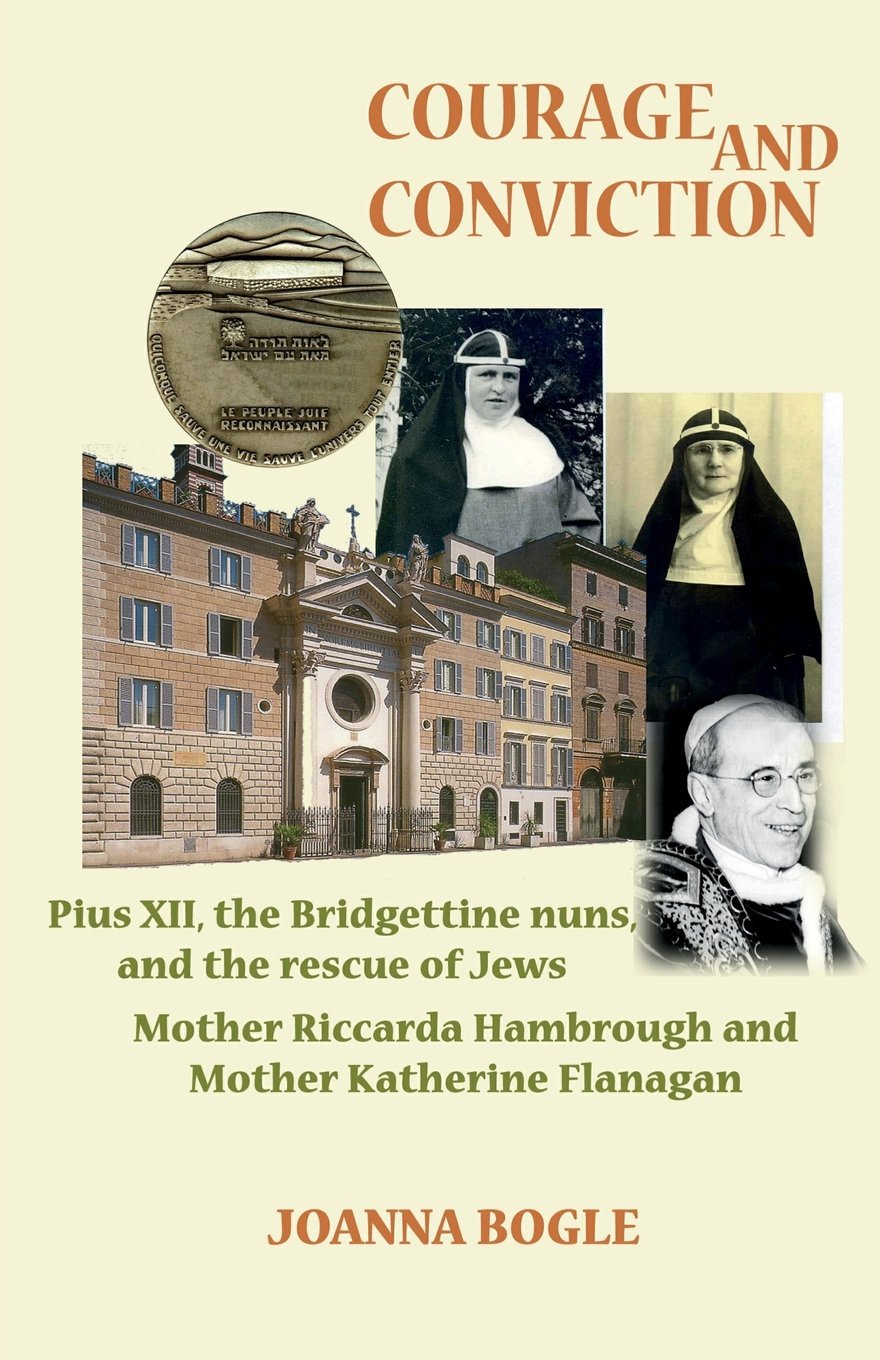
In a recent article published in The Catholic Herald, Dr Oddie began what looked to be a review of a new book by Joanna Bogle. However shortly after giving the reader a taste of what Bogle's book holds, and from what I have read by Oddie and Bogle, it looks like a book worth getting, Oddie launches into a a re-hash of many of the old chestnuts that apologists for Pius XII have used for decades.  Bogle's book concerns two English Bridgettine sisters who were active in rescuing Jews in Rome during the German occupation (September 1943-June 1944).  The story on its own looks to be a compelling one. It doesn't need to be turned into a propaganda item by those who wish to use any story of rescue for political ends.  I fear this is what Oddie has tried to do.

The insertion of a lengthy quote from David Dalin and recycling the long-debunked claims of Pinchas Lapide, lends aid to my fear that Oddie is more interested in keeping alive the dying flames of an old argument that most mainstream historians have long since walked away from.  The "vilifiers' of Pope Pius XII are not those who disagree with the ahistorical arguments of Dr Oddie and company, but rather the apologists themselves who dabble dangerously close to denialism and a reckless disregard for the truth.  It is Oddie and those who believe his version of events who insist on making the arguments for and against Pius XII a litmus test of Catholic orthodoxy.  Historians will keep on with the business of history.

Nonetheless, I look forward to reading Joanna Bogle's book.


Here is William Oddie's review:

Joanna Bogle has written prolifically and devotedly on a wide variety of subjects, always defending and proclaiming the values of the Catholic Church and aimed at nourishing in her readers the capacity to live the Catholic life; and her writings are undoubtedly an important part of what led recently to her deserved elevation to the rank of Dame of the Order of St Gregory. I have just read another of her books, shortly to be published by Gracewing, which everyone should read when it is published later this month: Courage and Conviction, the story of how two English Bridgettine sisters, Mother Riccarda Hambrough and Mother Katherine Flanagan, sheltered Jews in their convents during the German occupation of Rome. This account is invaluable, as a vivid insight into one small part of the much wider effort by religious houses and other Catholic institutions throughout Rome and the whole of Italy to shelter Jews from the Germans after the fall of Mussolini in 1943.

On the general question of Pius XII’s part in the shelter of Jews throughout Italy, Dame Joanna’s book is a useful guide, especially in the face of the persistent propaganda attempting to show that Pius XII was, to quote a particularly disgusting book title, “Hitler’s Pope”. As she points out, the majority of Italian Jews – some 80 percent – survived the Second World War, during the years when, across Europe 80 per cent of Jews died. She quotes J Lichten’s book [sic] A Question of Moral Judgement: Pius XII and the Jews,(1963) one among many accounts of what until recently was widely known and accepted by everyone (especially by leading Jews like Golda Meir), that “The Pope sent out the order that religious buildings were to give refuge to Jews, even at the price of great personal sacrifice on the part of their occupants; he released monasteries and convents from the cloister rule forbidding entry into these religious houses to all but a few specified outsiders, so that they could be used as hiding places. Thousands of Jews – the figures run from 4,000 to 7,000 – were hidden, fed, clothed, and bedded in the 180 known places of refuge in Vatican City, churches and basilicas, Church administrative buildings, and parish houses. Unknown numbers of Jews were sheltered in Castel Gandolfo, the site of the Pope’s summer residence [according to Rabbi David Dalin, at least 3,000 found refuge there], private homes, hospitals, and nursing institutions; and the Pope took personal responsibility for the care of the children of Jews deported from Italy.”

As Dame Joanna points out, the scale of the rescue operation was huge. In the City of Rome itself 155 convents and monasteries sheltered around 5,000 Jews. Sixty Jews lived for nine months at the Gregorian University, and a considerable number in the cellar of the Pontifical biblical institute. One could go on at wearying length.

The story of the English Bridgettines, Mother Riccarda Hambrough and Mother Katherine Flanagan, is one small and typically courageous part of the huge operation that Pius set under way. What emerges vividly is not only the vital part played by the Pope himself; but the indispensable part played by the faith and courage of so many individual Catholics who obeyed his call.

Mother Riccarda hid about 60 Italian Jews from the Nazis in her Rome convent, the Casa di Santa Brigida. She was baptised at St Mary Magdalene’s, Brighton, at the age of four after her parents converted to the Catholic faith. She was guided towards the Bridgettine Order by Fr Benedict Williamson, who was the parish priest of St Gregory’s Parish, Earlsfield, between 1909 and 1915. Sister Katherine Flanagan, too, was guided by Fr Williamson and also joined the Bridgettine sisters.

What is striking is the way in which, as far as possible, the Sisters made it possible for those they sheltered, not simply to cower in hiding, but to live normal and dignified lives. One refugee remembered that they had asked for refuge, but without saying at first they were Jews. They went to Mass, copying what the Catholics did. They were soon told that “we must live our own beliefs, that we should not feel any need to pretend, and that we must live and pray as Jews”. The same refugee told Dame Joanna last year (this book is not a scissors and paste job), that “I was even able to continue my education: a lady professor, a Jewish lady, came in and gave me lessons. She taught me Latin. We studied Tacitus and I became really engrossed in it. It was particularly important for me because earlier the Jews had been kicked out of all the schools, and I could have missed out on the chance of an education. But because of this tutoring, when the Allies arrived and we were liberated, I hadn’t missed a year of my schooling”.

The present Mother superior of St Birgitta’s, Mother Thekla, who knew Mother Riccarda well, remembers that she was “was truly very beautiful. She was a wonderful person — an angel on the earth. And she was humble—she had this spirit of service, of simply wanting to serve and help people”. This is an inspiring story, simply but powerfully told. “Above all”, remembers Mother Thekla, “[Mother Riccarda] had a profound respect for these Jewish guests. It was important not to let them feel humiliated by their situation—they were vulnerable, and it was crucial to let them know that they were welcome and that the sisters wanted to help them in any way they could.”

By concentrating on the Bridgettines in Rome, Dame Joanna has vividly brought to life a microcosm of what was happening wherever there was German occupation after the fall of Mussolini. Multiply this account by a thousand, and you have some idea of what the Catholic Church in Italy, directly inspired by the Pope himself, believed it had a vocation to accomplish.

By no means all Jewish writers today have uncritically accepted the torrent of anti-Pius propaganda, the contents of which over recent decades have generally been assumed by the secular media (and even by some Catholics) to be well-founded. As Rabbi David Dalin has written in a lengthy and important article, well worth reading carefully and in full, though Pius has had his defenders recently,

…. it is the books vilifying the pope that have received most of the attention, particularly         Hitler’s Pope, a widely reviewed volume marketed with the announcement that Pius XII was “the most dangerous churchman in modern history,” without whom “Hitler might never have . . . been able to press forward.” The “silence” of the pope is becoming more and more firmly established as settled opinion in the American media: “Pius XII’s elevation of Catholic self-interest over Catholic conscience was the lowest point in modern Catholic history,” the New York Times remarked, almost in passing, in a review last month of Carroll’s Constantine’s Sword.

Curiously, nearly everyone pressing this line today — from the ex-seminarians John Cornwell and Garry Wills to the ex-priest James Carroll — is a lapsed or angry Catholic. For Jewish leaders of a previous generation, the campaign against Pius XII would have been a source of shock. During and after the war, many well-known Jews – Albert Einstein, Golda Meir, Moshe Sharett, Rabbi Isaac Herzog, and innumerable others —publicly expressed their gratitude to Pius. In his 1967 book Three Popes and the Jews, the diplomat Pinchas Lapide (who served as Israeli consul in Milan and interviewed Italian Holocaust survivors) declared Pius XII “was instrumental in saving at least 700,000, but probably as many as 860,00 Jews from certain death at Nazi hands.” 

In the end, that truth will once again become generally accepted. When it is, Joanna Bogle’s important new book will have played its part.


Friday, December 3, 2010

Bob Keeler of Newsday: Deciphering the latest from Pope Benedict

Bob Keeler contacted me via the Anti-Defamation League early in the week for some comment on the pope's comments on Pius XII.  Bob was upfront with me writing that the column was fairly short - he wasn't wrong!  Nonetheless, I think it is a solid piece of writing.  He tells me he has had a lot of positive response along with a few less than positive comments.  I can not over-emphasise the role the historian plays in the process of analysing the story of Pius XII.  It is a slow and painstaking process.  And it was ever so.

Newsday (New York)

December 2, 2010 Thursday

ALL EDITIONS

Deciphering the latest from Pope Benedict; Statements on condoms and Pius XII lead observers and the faithful to seek clarity

BYLINE: BOB KEELER.

Bob Keeler is a member of Newsday's editorial board.

The world knows Pope Benedict XVI as a quiet and careful theologian. But he also knows how to kick up a fuss now and then, like the buzz for his new book.

No, the pope himself didn't set up a publicity campaign around two newsy quotes from the book, a long interview with German journalist Peter Seewald. But those were the bits the news cycle gave us, and they sure got our attention.

The biggest flap was over condoms. The hot issue now is their use in preventing AIDS. But four decades ago, it was about preventing pregnancy.

In the 1968 encyclical "Humanae Vitae," about "the transmission of human life," Pope Paul VI affirmed the church's opposition to contraception - even though the 1966 majority report of a papal commission recommended easing the ban.

So, what did Benedict just say? "There may be a basis in the case of some individuals, as perhaps when a male prostitute uses a condom, where this can be a first step in the direction of a moralization."


That odd example triggered much debate over how much Benedict intended to signal. Bottom line: It may make it easier for some bishops to accept condom use against the spread of AIDS, but the basic directive to families is unchanged.

"If you were going to change the fundamental teaching, no pope is going to do it in a book," said the Rev. Charles Curran, a moral theologian at Southern Methodist University, who lost his right to teach as a Catholic theologian over "errors" in his work on sexuality. Benedict, then Cardinal Joseph Ratzinger, was his inquisitor.

In his other buzz-maker, Benedict said we must acknowledge that Pope Pius XII "was one of the great righteous men and that he saved more Jews than anyone else." The result: pained statements from the Anti-Defamation League and other key Jewish groups.

It's a fight we need to avoid.

This issue didn't heat up until a 1963 play, "The Deputy," demonized Pius as silent in the face of the Holocaust. Then in 1967, a book by Israeli journalist Pinchas Lapide offered a counter view, saying Pius had saved 800,000 Jewish lives.

Those are the issue's broad boundaries. But we won't know the whole story until all of the Vatican's World War II-era archives are made available.

A group of Catholic and Jewish scholars seeking a more definitive answer to Pius' role in the Holocaust studied the 11 volumes that had been released so far and in the year 2000 raised 47 questions. Answering them would have required more documents. But the Vatican said it wouldn't release the other documents soon, partly for lack of archival staff. So the scholars suspended work in 2001.

Last year, it heated up again, when Benedict recognized the "heroic virtues" of Pius and John Paul, putting both on the path to canonization. On Pius, Jewish leaders said, "Whoa!"

And they're right. We made too much real progress on Catholic-Jewish relations under John Paul - with Ratzinger's collaboration - to damage it now.

And what's the big rush? "My plea to the 'canonize him now' people is to show some patience, admit he made mistakes and wait for the material to be analyzed professionally," said Paul O'Shea, an Australian historian who wrote a book on Pius, "A Cross Too Heavy."

Whatever the final verdict - probably a lot softer than "The Deputy" - moving Pius' sainthood too fast is unnecessary and insensitive to our elder brothers in the faith, to use John Paul's lovely phrase.

Instead, let's move fast on candidates who evoke more fervid devotion: Dorothy Day, Oscar Romero, and the four church women martyred in El Salvador 30 years ago today. And let's tone down the Pius rhetoric, on both sides.

Monday, April 19, 2010

Official - there is no Pius XII forest in Israel

In an earlier post about Pinchas Lapide, I mentioned one of the "throw away" lines in his book:

"No Pope in history has been thanked more heartily by Jews . . . .Several suggested in open letters that a Pope Pius XII forest of 860,000 trees be planted on the hills of Judea in order to fittingly honor the memory of the late Pontiff ("Three Popes and the Jews" pp. 214–215)."

A number of rather extreme and conservative Catholic websites have turned the suggestion into what they believe to be is fact.  They believe there is a forest of 800,000 or 860,000 trees in Israel.  And I have copped a shellacking from one poster on an Australian discussion board over it and every other post about Pius with which he takes (a totally a-historical and ill informed) exception.

In mid-March this year I wrote to colleagues in Israel asking them to give me an authoritative answer to this allegation, just to settle the issue once and for all.

Today I received this reply:

Sorry it took so long, but since nobody at Yad Vashem had ever heard about these trees, I put in a request for information from the Keren Kayemeth, which deal with the planting of trees in Israel. They told us that they are unaware of any such trees, planted in honor of Pius XII. In fact they are unaware of any trees planted at all in honor of Pius XII.

I hope this is an end to one of the more bizarre myths about Pope Pius.

Saturday, April 3, 2010

Pinchas Lapide and Rubbery Figures

In his book “The Last Three Popes and the Jews” (1967), Pinchas Lapide claimed that Pius XII was responsible for saving the lives of 860,000 Jews. I remember the first time I read Lapide’s book and the sense of amazement that Pius had been so active in saving Jewish lives. In the 20 years or so since I first read “The Last Three Popes” I have done a lot of work in studying, researching, teaching and writing about the Holocaust. While I did not give Lapide much, if any thought, in my studies, occasionally I wondered “Where did he get the numbers from?” It has only been in the last few months when I decided to launch the blog that I considered it was time to have a proper look at Lapide’s claim that has been used as one of the major arguments to support the thesis that Pope Pius XII was the greatest rescuer of Jews during the Holocaust.

But first, a couple of myths need to be dispelled. On a number of historically uncritical websites, blogs and in more than a few books, Lapide is described as a diplomat and a rabbi. As far as I can tell from the few sites that have detailed information about Lapide he never received smicha (rabbinical ordination), and was in diplomatic service from 1951 to 1962 holding several relatively minor roles in Milan, Rio and Jerusalem.

I have yet to find any source that claims Lapide was an historian. He held degrees in languages, biblical studies and political science. His great passion was interfaith dialogue between Judaism and Christianity.

Who was Lapide?

Pinchas Lapide was born in Vienna, Austria on 28 November 1922. After the Anchluss in March 1938 and a short term of imprisonment in a concentration camp near the Czech border, Lapide managed to make his way into Poland and from there to Britain before arriving in Palestine on the last ship to reach the Mandate in 1940 where he worked on a kibbutz near Haifa. He enlisted in the British Eighth Army in 1941 and eventually served in Italy as part of the Jewish Brigade. At war’s end he served as a liaison officer between the Americans and Russians in Vienna.

Remaining in Vienna after demobilisation in 1945, Lapide studied languages for a year at Vienna University. In 1947 he returned to Palestine and studied under Martin Buber as well as pursuing his now growing interest in early Jewish-Christian history. He fought in the Israeli wars of Independence after which he resumed studies at the Hebrew University in Jerusalem. In 1951 Lapide entered the Israeli diplomatic service and worked in Milan where he met Archbishop Giovanni Battista Montini, the future Pope Paul VI. During this time he met and married Ruth Rosenblatt (1929- ) with whom he shared a common interest in Jewish-Christian dialogue.

Lapide was involved in the Israeli government’s preparation for the visit of Paul VI to Israel in 1964. At the same time he was Deputy Director of the National Press Office in Israel. Lapide’s commitment to study did not wane. He pursued studies in languages, medieval history and political science alongside his passion, early Jewish-Christian history. He was proficient in Italian, Russian, French, German, Hebrew and English. In 1967 he wrote his most famous work Rom und die Juden, translated as “The Last Three Popes and the Jews”.

In 1969 Lapide and his family moved from Israel to Cologne, Germany. He studied at the Martin Buber Institute for Jewish Studies and completed a PhD on the subject of Hebrew usage in Christian religious communities in the land of Israel. From 1971 Lapide was resident in Frankfurt am Main. For the rest of his life, Pinchas Lapide worked for reconciliation between Jews and Christians. He was honoured for his work by the Federal Republic of Germany in 1993 with the Great Federal Cross of Merit; and his adopted city, Frankfurt, which struck a medal in his name. Lapide died on 23 October 1997.

Lapide’s published works cover topics around the areas of early Jewish-Christian history. His studies at tertiary levels were in the areas of languages, biblical studies, medieval history and political science.

Lapide and Interfaith Dialogue, History and Popes.

It is reasonably clear that Pinchas Lapide was passionate about Jewish-Christian dialogue in a time when such dialogue was just emerging. “The Last Three Popes” was published just two years after Nostrae Aetate and well before the major dialogues between the Judaism and Christianity were part of the regular pattern of religious life for either tradition. I suggest that Lapide’s non-critical examination of the role of the Catholic Church during the Holocaust comes from his eagerness to promote good relations between the official Church and, understandably, sceptical Jewish communities. The book demonstrates a basic knowledge of the history of Jewish-Christian relations in the first half of the 20th century, but does not seem to grasp the complexities that characterised Catholic responses and reactions to Fascism, Communism and Democracy.

Lapide does not explain, in a satisfactory or reliable way, how he reached the figure of 860,000 rescued Jews in his discussion of Pius XII. On pages 214 and 215 of “The Last Three Popes” (Souvenir, London) Lapide wrote:

"The Catholic Church, under the pontificate of Pius XII was instrumental in saving at least 700,000 but probably as many as 860,000 Jews from certain death at Nazi hands"

Estimating that 1.3 million of Europe’s pre-war Jewish population survived, Lapide then subtracted numbers based on what he said were “reasonable claims” of rescue made by Protestant Christians, Communists, agnostics and other non-Jews. Jose Maria Sanchez, author of “Pius XII and the Holocaust: Understanding the Controversy” (CUA Press 2002) and arguably one of the most conservatively balanced writers on Pius, wrote:

Lapide gives no documentation for this figure or his exact calculations. It should be noted that Lapide does not say that Pius saved the Jews, only that the saving occurred “under the pontificate of Pius XII.” The undocumented calculation and suggestive wording have been ignored by Pius’ defenders. Their uncritical acceptance of Lapide’s statistics and statements has weakened their arguments. (Sanchez, 140)

Ronald Rychlak, William Doino, David Dalin and Margherita Marchione are among writers who consistently use Lapide’s figure to support their arguments.

In summary, the figure of 860,000 is a creation of Pinchas Lapide and nothing else. It has no basis in historical fact.

Most Holocaust historians such as Raul Hilberg, Yehuda Bauer, Lucy Dawidowicz, Martin Gilbert, David Bankier, Michael Berenbaum and Saul Friedlander, support the thesis that the number of dead lie between Raul Hilberg’s 5.1 million and Wolfgang Benz’s outer limit of 6.2 million. The reason for the discrepancy lies in the lack of verifiable data. The Germans kept lists for many of the killing sites, but some of the lists contain estimates, and it was not uncommon for these to be inflated in order to impress superiors in Berlin.

Lucy Dawidowicz is regarded as having created a reliable summary in her book “The War Against the Jews” (1986): of a European pre-war population estimated at 8.861 million, approximately 5.933 were murdered – c67%. The surviving number – 2.983 million are accounted through migration either pre-war or after war began, depending on location; Soviet Jews in European Russia who fled eastwards after June 1941; Jews hidden in occupied territories either by non-Jews or with other Jews in places such as forests and partisan groups; survivors of camps and ghettoes. The number of Jews rescued by Catholics will never be known with accuracy because of the variables related to the reality of rescue.

Lapide also mentioned that in 1958 there were calls to plant a forest of 860,000 trees in memory of the Jews saved by Catholics during the Holocaust. This “throw away” line has entered the mythology of some “canonise-him-now” groups, who believe that such a forest exists. Recent emails to friends in Israel have discovered no forest. It has never existed, and most likely, never will.