Thursday, March 31, 2011

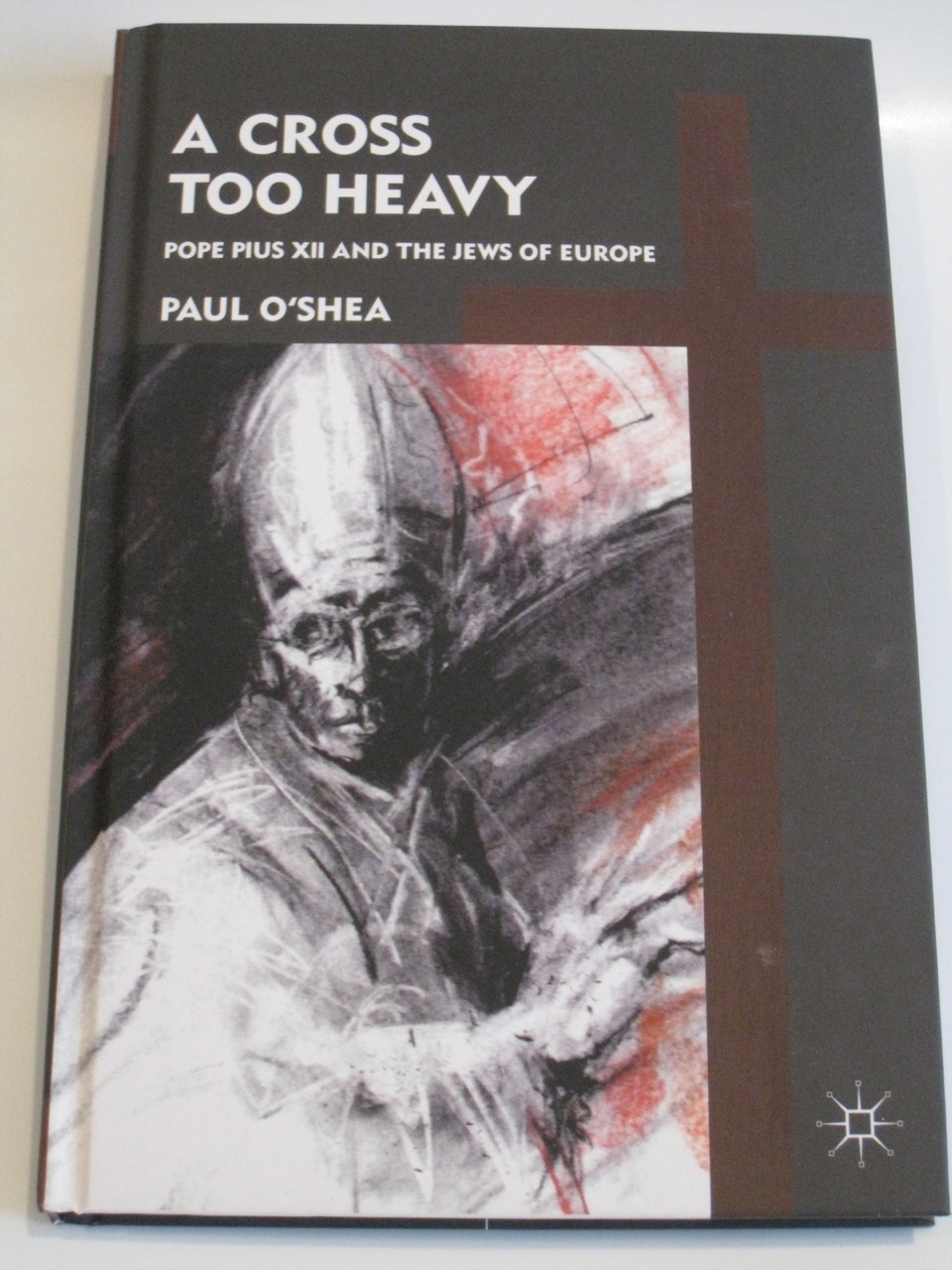
A Cross Too Heavy: Pius XII and the Jews of Europe

It is not without some sense of pride and joy that I opened up a box that had been delivered by UPS yesterday.  The US edition of the book has arrived.  Palgrave Macmillan have done a sterling job.  When I get over the "Wow" moment, I will start writing the thank you letters to so many people who have made this moment possible.

The substance of the 2011 edition is in accord with the 2008 Australian publication.  I added some more archival references and re-wrote the introduction with a more critical appraisal of the neo-conservatives who continue to use polemic to push their agenda with Pius XII.

I want to thank, on this blog, the help and support of Abraham Foxman, National Director of the Anti-Defamation League, New York.  Abe asked to meet this unknown writer from "Down Under" and asked straight out "what's your gut feeling on Pius?".  It has been in no small part due to Abe's "go get 'em" work ethic that this project saw the light of day.

Rabbi Eric Greenberg, Deborah Dwork, Amy-Jill Levine, the archivists at the Vatican Secret Archives, Thomas Brechenmacher, Hubert Wolf, Susan Zuccotti, Michael Phayer, Colin Tatz, Yehuda Bauer, John Pawlikowski and Victoria Barnett, have, all in their own wonderful ways, been guides and gurus.  I owe each one a huge measure of gratitude.

And to my agent, Lynne Rabinoff - thank you, thank you, thank you.


http://us.macmillan.com/acrosstooheavy

Wednesday, March 30, 2011

Judeophobia and some reactionary Catholics

Earlier this month I posted comments on Pope Benedict XVI's new book Jesus of Nazareth: Holy Week, where the pope repudiated any and all charges of Jewish responsibility for the death of Jesus.  There has been near universal praise for Benedict's writing. 


However, it should not come as a surprise that there are some who do not share the view of the pope and mainstream Catholic teaching.  One such group is the Society of St Pius X, a fringe group of disaffected Catholics who believe the Church has been in error since Vatican II. 

Among issues the Society believe point to mainstream Catholicism's departure from the "true faith" are inter-religious dialogue and the Church's relationship with Jews and Judaism.  The article below is from the Society's US website and contains a mish-mash of pseudo-theologies that have been comprehensively rejected by the Catholic Church at Vatican II and in the teaching of the popes since.

It is worth recalling that one of the Society's bishops is Richard Williamson, a known Holocaust denier.  Even though SSPX has distanced itself from Williamson, it is no coincidence that the supercessionist theology taught by the Society would encourage people such as Williamson to indulge in their offensive judeophobias.

The article makes for some rather disturbing reading.

Gesture to the Jews from Benedict ...as Pope or Professor?


Pope Benedict XVI has made a sweeping exoneration of the Jewish people for the death of Jesus Christ in his new book, the second volume of Jesus of Nazareth. This should not be surprising since it follows Nostra Aetate, which initiated a revolution of the Church’s relations with Jews. In this new book, Benedict attempts to explain, biblically

For Benedict, the responsibility of Christ’s death is allocated instead to the “Temple aristocracy” and a few supporters of Barabbas who were responsible. Benedict asks: “How could the whole [Jewish] people have been present at this moment to clamor for Jesus’ death?” He deconstructs the famous phrase of the crowd: “His blood be on us and on our children”, a phrase frequently cited as evidence of the collective guilt that the Jews bore and the curse they carried as a result. Benedict, however, argues that Jesus’ blood “does not cry out for vengeance and punishment, it is not poured out against anyone, it is poured out for many, for all.”

He has visited the Nazi concentration camp of Auschwitz in Poland and Israel’s Yad Vashem Holocaust memorial, in spite of the fact that Jewish groups oppose the beatification process of Pius XII, whom they claim should have done more to prevent the Holocaust.

Finally, Benedict approvingly quotes the Cistercian abbess Hildegard: “The Church must not concern herself with the conversion of the Jews, since she must wait for the time fixed for this by God.” Until God’s plan comes to fruition, Benedict says, the “particular task” of the disciples of Christ is to carry the Faith to the Gentiles, not to the Jews.

Concerning Pope Benedict’s interpretation, the following reflections are offered:

The responsibility of the Jewish people as such for the death of Christ has been the constant teaching of the Magisterium, based on Scripture and the Church Fathers. St. John speaks three times in his Prologue of the rejection of Christ by His own (meaning His own people or nation). Romans XII speaks of the rejection of Israel for the profit of the Gentiles. See also St. Augustine’s Treatise 49 On John, near the end: “The chief priests and the Pharisees took counsel together...’If we let Him alone as He is, all will believe in Him, and the Romans will come and take away both our place and our nation.’ Fearing the destruction of temporal things, they took no thought of eternal life, and so they lost both. After the Lord’s Passion and glorification the Romans did indeed take away both their place and their nation, by assault on the city and dispersal of the people.” The Fathers connected the punishment of the loss of the nation to the crime of deicide, perpetrated by the highest ranking political and moral authority: the Sanhedrin.

It is important to distinguish today between the Jewish race (which has little to do with Christ’s crucifixion), present day Israel (including the Zionists who were forced to emigrated mostly from Russia), and the Jewish religion (led by rabbis, the doctrinal successors of the Sanhedrin which rejected Christ).

As the Messiah was the whole purpose of Israel, His acceptance by many Gentiles turned them into the true Israel (according to St. Paul) and, similarly, His rejection by many Jews could not but be their undoing, since “God is not mocked.”

Such theological interpretations, based on Romans XII, or the Jewish responsibility for Christ’s death have certainly not been the justification for any alleged Jewish persecution by the Church in the Middle Ages. Witness the sermons of St. Bernard, forbidding the killing of Jews; if there was any pressure from the side of the Church, it was not against them but on their behalf.

Regarding the idea of dialogue vs. conversion, the late Cardinal Dulles provided a blunt assessment about ten years ago: the Church cannot curtail the scope of the Gospel without betraying Herself.

John Vennari (editor of Catholic Family News) recounts hearing a Jewish rabbi (note 1) say that the Gospel account of the Passion is not accurate: that the Pharisees were not hostile to Our Lord, but that they were trying to warn Christ against Pilate’s treachery. Mr. Vennari also reports that this rabbi from the Anti-Defamation League works in union with the United States Conference of Catholic Bishops which allows him to teach these falsehoods to Catholics everywhere through the United States.

Footnote


1)  John Vennari said the Rabbi’s name was Rabbi Leon Klenicki, who died in 2009. In 2007, Pope Benedict named Rabbi Klenicki a Papal Knight of the Order of St. Gregory the Great.

Wednesday, March 23, 2011

Robert Ventresca on access to the war archives

The Vatican and the Holocaust: waiting for the critical documents.

Robert Ventresca's latest article taken from the National Post (Canada) on current research into Pius XII is both scholarly and timely.

For 40 years now the Vatican consistently has demonstrated initiative in the field of Catholic-Jewish relations. Every Pope since John XXIII has shown foresight in promoting mutual understanding and dialogue between Catholics and Jews. With the publication of the second volume of his book on the life of Jesus, Jesus of Nazareth, Benedict XVI continues in this tradition by affirming, among other things, that Jewish-Christian relations over the centuries has been marred by “misunderstandings” which have “weighed down our history.”


Chief among these deeply consequential misunderstandings has been the stubborn myth that the Jews were responsible for the death of Jesus. In a stimulating review of the Pope’s new book, Geza Vermes, a distinguished professor of Jewish studies at Oxford, rightly applauds Benedict’s “courage for a Christian leader of his disposition” in conceding that parts of the gospel account of Jewish responsibility for the death of Christ should not to be taken as “historical fact.”

In a similar vein, Benedict XVI could make history if he were to take another courageous move to accelerate the opening of the Vatican’s wartime archives. In doing so, the Pope would help to pave the way for a full and proper historical assessment of the Vatican’s response to the Holocaust.


For all of the strides made since the 1960s in Jewish-Catholic relations, open questions over the Vatican’s role during the Second World War, especially its response to Nazi persecution of Jews, remain an obvious source of misunderstanding — exacerbated unnecessarily by the sluggish pace to fulfill the promise to make access to the wartime archives a priority.


The extent to which the archives issue remains a real sore spot was evident at a recent international gathering in Paris, convened to celebrate 40 years of constructive Jewish-Catholic dialogue, when the Anti-Defamation League (ADL) reiterated its call for the Vatican to work with qualified scholars and institutions to facilitate immediate access to all the unpublished files of the Vatican’s wartime archives.


Particularly troubling for the ADL, and for a dedicated contingent of eager historians around the world, is the absence of a consistent, concrete timetable for open access. At one time, there were widespread expectations that the records would be catalogued and open to researchers by 2011-2012. In 2010, though, Bishop Sergio Pagano, the Prefect of the Vatican Secret Archives, tempered these hopes by pointing out that the “technical preparation” of some 16 million documents from Pius XII’s 19-year long pontificate will not be completed until 2015 at the earliest. Even then, the reigning Pope will have to make a final decision on when to make these records available to researchers.


Patience may well be a virtue but, as the ADL’s Rabbi Eric Greenberg suggested in Paris recently, for Holocaust survivors and their families, the time to act is now.


There is a simple but compelling logic to Rabbi Greenberg’s point that what is at stake here is “truth and historical accuracy.” Greenberg reasons that opening the archives now would have profound symbolic meaning for aging survivors and their families, whatever the documentation were to show.


Vatican officials have long maintained that open access to the documentation from Pius XII’s pontificate, including the war years, is not yet feasible on a technicality. The concerns are eminently reasonable. For instance, it is clear that the task of cataloguing such a vast, complex collection has strained the material limits of existing resources. Those of us who have worked in the Vatican archives know well the breadth, depth and complexity of the collections. We know too how support systems are being strained by the increased demand for access to this unique repository of precious documentation.

Where there is the proverbial will, of course, there is a way.

Successive Popes have proved as much through a series of authoritative moves. The cake of custom broke decisively in 1964 when Paul VI authorized a team of respected Jesuit scholars to edit and publish select portions of the wartime archives, drawn largely from the records of the Vatican’s political and diplomatic offices. The result, of course, is the set of 11 massive volumes of documentation that remains to this day the single most important published source of information about the Vatican’s wartime policies.


The Vatican has no hard and fast rule about access to its archives, and, as always, papal discretion reigns supreme. The general rule has been to leave the archives closed for at least 100 years after a given period or event. Here, too, though the Popes have taken the lead in setting precedent. Consider, in particular, Benedict’s remarkable decision in 2006 to open the archives for the entire pontificate of Pius XI (1922-1939). This gave researchers unprecedented access to the Vatican’s most sensitive documents from the troubled decades in between the two world wars. Among the real gems of this collection are the personal notes of Pius XI’s Secretary of State in the 1930s, Eugenio Pacelli – the future Pius XII.

In opening modern papal archives to the scrutiny of historical research, the Popes have demonstrated a serious commitment to deliver on the Church’s promise to confront its past with honesty and scientific rigour. John Paul II once said that the Church “is not afraid of the truth that emerges from history,” adding that it entrusts the study of the past to “patient, honest, scholarly reconstruction.”


Historians are uniquely placed to take up the work of honest reconstruction of the past. As John Paul II put it, “this is the reason why the first step [historical judgment] consists in asking the historians to offer help toward a reconstruction, as precise as possible, of the events, of the customs, of the mentality of the time, in light of the historical context of the epoch.”

Historians stand at the ready to help towards just such a precise reconstruction of the past. But we need the meaningful collaboration of the Vatican archives to permit us to do our work to the best of our ability, in keeping with the conventions of our craft. Hence the powerful logic of these renewed calls for immediate access to the Vatican’s wartime archives.

Selective access to the documents begets a selective reading of history. The image that emerges of Pius XII and the Vatican during the war inevitably is partial, provisional and vulnerable to manipulation by apologist and critic alike. Worst of all, selective access to the archives continues to feed the suspicion of critics who already are prone to see a cover-up behind those imposing Vatican walls.

For the sake of truth and accuracy, and to pay homage to decades of fruitful Catholic-Jewish dialogue, it should be possible to conceive of the means by which serious scholars and institutions can be invited to the table to consider even a targeted study of the wartime archives. This would help to begin to answer some of the most contentious, most relevant questions. It would also be an act of good faith, commensurate with the Church’s stated commitment to furthering Jewish-Catholic understanding and interaction.

It could temper fears of a premature move to have Pius XII made a saint, and would bring the methods of historical scholarship to bear as the Vatican studies this controversial cause. There may very well be ample justification to consider Pius XII a worthy candidate for sainthood. But it would be hazardous for the Holy See to delude itself into thinking that it has at its disposal a definitive historical assessment of this long, pioneering but complex pontificate.

It may be that even with the opening of the rest of the archives we will find ourselves no further along than we are at present. Yet, even if the enigma remains around the controversial wartime Pope, at least the stigma of secrecy stemming from the current state of archival access would be alleviated; maybe even removed entirely.


R. A. Ventresca is a historian at King’s University College at The University of Western Ontario and is currently writing a book on Pope Pius XII.


.

Saturday, March 19, 2011

ADSS 6 Document 3 and the Attachments

Gabriel Wilensky alerted to me Michael Hesemann's latest attempt at historical revisionism.  I went to Gabriel's blog on his website - Six Million Crucifixions - and read Michael Hesemann's response to the original post.  It makes for VERY interesting reading (for those who are interested in the minutiae of papal archives - like me!)  On a serious note, Hesemann's manipulation of historical records to make claims that just don't bear closer scrutiny ruin his own integrity, not that of historians undertaking research into papacy of Pius XII. 

Rather than launch into a polemic, I am posting a summary of what this particular collection of documents does say.

ADSS Volume 6, Document 3. (pages 45-52)

Context: 

Upon his election as pope on 3 March 1939, Pius XII was approached by many different groups, similar to lobby groups, appealing for papal support for various works.  Among them was a representation sent to Pius by a Dutch-based committee for refugees.  The two men who wrote to the pope were both well known in refugee circles in the late 1930s.  The letter is followed by several attachments.  The six documents are footnoted with considerable details regarding the people mentioned and other relevant facts.  For brevity's sake I have left most of them out.  The interested reader can find them online at the Vatican's website or Pave The Way. (Registration is required to access material via PTW).

The authors:

Josef Ignaz Julius Schmutzer (1882-1946), was a geology professor at the university of Utrecht. He was also President of the National Committee for Refugees (founded 1936) and President of the International Catholic Bureau for Refugee Affairs (founded 1938).  He was also active in the Roman Catholic State Party, a Dutch Catholic political party that attempted to incorporate Catholics into full participation in the life of the state.  After the German invasion of Holland in May 1940, Schmutzer was arrested and sent to Sachsenhausen and then Buchenwald concentration camps before being returned to Holland and incarcerated in local camps from where he eventually escaped.  As Holland was liberated, Schmutzer, who had been in hiding, was appointed minister of overseas territories.  He returned to Utrecht but the effects of the war proved too much and he died in September 1946.

The second author of the March 1939 letter was Fr Francis Mary Strathmann, (1883-1971) a German Dominican.  The following information was supplied by Fr Elias Füllenbach, Dominican archivist in Düsseldorf and the Dominican history found on the German provincial website.  Strathmann entered the Dominicans in 1905 and shortly after his ordination in 1914 became active in peace movements.  He remained a convinced pacifist all his life.  In 1933 he wrote to Cardinal Faulhaber in Munich recounting his experience of the government organised boycott of Jewish businesses and his dismay at the role played by more than a few Catholic priests in supporting antisemitic action.  His outspoken criticism of the regime led to his arrest in July 1933.  The Dominicans were able to secure Strathmann's release and sent him to Rome where he remained until November of that year before heading to Holland where he became involved in refugee assistance.  At some point Strathmann met Schmutzer and the two men began collaborators.  Strathmann survived the war avoiding contact with the Germans largely through the assistance of the Dominican nuns in Belgium.  He returned to Germany in 1947 and attempted to revive his peace activities.


Francis Strathmann OP (1938)

The document:

Holy Father,


On 09.01.1939 while Your Holiness was still Cardinal Secretary of State to Pius XI, you wrote a letter to the Bishops [Attachment 2, pp 48-49], which referred to the necessity demanded of brotherly love to care for the many non-Aryan Catholics forced to emigrate and become refugees.

Your Holiness remembers that in 1936 in Utrecht the first Catholic Committee for Refugees was the first one founded. In these two years our committee has undertaken a very extensive activity and has been able to help numerous refugees find new lives abroad.

It hardly requires the mention that the committee acts in a completely non-political manner and is purely concerned with charitable works.

The welfare service work for refugees performed by our committee has helped many emigrate overseas, particularly to Brasil.

The emigration problem has become so large of late that it is need of extension and expansion as the existing auxiliary equipment is short. The most urgent need appears at present centralization of the existing Catholic refugee committees in a yet to be created international head office.

The Protestant and Jewish Committees have done this and are, consequently, much better able to work consistently and in a positive relationship with the League of Nations High Commissioner for Refugees for the care of the refugees.

The High Commissioner, Sir Herbert Emerson, has personally expressed that it is not possible for him to negotiate with all individual Catholic Committees, and asks for a single central Catholic agency similar to the Protestant and Jewish agencies.

An approved Catholic Central Bureau for Refugee Affairs could then also be far more ambitious in the carrying out of the instructions set out in Your Holiness’ letter of 9 January 1939 to the reverend bishops.

We take our task to show the whole world, in serving Christ in the persecuted, as an apostolate which is significant enough to join, even as a smaller agency, the great work of Catholic mission. We believe this work to be the will of God, a “crusade for God and neighbour”.

We would be very happy if your Holiness would approve and bless this work. The inner and outer support of this work will be more valuable with the express approval and recommendation of Your Holiness.


Humbly prostrate at the feet of Your Holiness we ask for this grace and remain with deepest reverence and perfect obedience.

The Attachments:

1. (pages 47-48) Cover letter from Paolo Giobbe, Internuncio to the Hague to the Secretary of State. Cardinal Luigi Maglione, supporting the request from Professor Schmutzer.

2. (pages 48-49) Circular letter of Cardinal Pacelli, 09.01.1939 relaying instructions from Pius XI recommending the formation of committees of assistance for an estimated 200,000 Non-Aryan Catholics.  This letter was sent to the Archbishops of England, Ireland, Scotland, Canada, the USA, Costa Rica, Chile, Columbia, Argentina. (Footnote 2, page 45)

3. (pages 49-50) Circular letter from Cardinal Pacelli, 30.11.1939 , addressed to the representatives of the Holy See in Ireland, Argentina, Chile, Peru, Bolivia, Columbia, Cuba, Costa Rica, the USA, Australia, Turkey, Belgian Congo, French Indo-China, Lebanon, Egypt and South Africa.  Pacelli relayed instructions from Pius XI asking the papal representatives to do whatever they could for converted Jews forced to flee Germany and Italy.

4. (pages 50-51) Circular letter from Cardinal Pacelli, 10.01.1939, addressed to the Cardinal Archbishops of Boston, Philadelphia, Chicago, Quebec and Buenos Aires.  Pacelli relayed  instructions from Pius XI to help Jews forced to leave Germany.

5. (pages 51-52) Undated promemoria of Cardinal Giovanni Mercati (1866-1957), Vatican Archivist and Librarian, writes of the precarious situation of Jewish scholars in Germany and makes an appeal to American universities.

Michael Hesemann's claim:

I never denied that the main document of the stock I found in the Vatican Secret Archives was already quoted in the “Actes et Documents du Saint Siege relatifs a la Seconde Guerre Mondiale”, vol. 6, Citta del Vaticana 1972, p. 48-50.


What I discovered and what was NEVER published before is the distribution list, the list of recipients: For the telegraph of November 30, 1938, asking the Nuntiatures in Ireland, Argentina, Chile, Peru, Bolivia, Columbia, Cuba, Central America and Lithuania as well as the Apostolic Delegations in the U.S., Australia, Albania, Belgish Congo, Indochina, Syria, Egypt and Central Africa for urgent help to request invitations, jobs and visa German Jews, as well as for the letter to the Bishops and Archbishops of the Catholic World of January 9, 1939, namely of Lima/Peru; Quito/Ecuador; Merida and Santiago/Venezuela; Hobart, Adelaide, Brisbane, Melbourne,Perth, Sydney/Australia; Westminster, Birmingham, Cardiff, Liverpool/England; Armagh, Cashel, Dublin, Tuam/Ireland; Edinburg/Scotland; Kaunas/Lithuania; Utrecht/Netherlands; Luxemburg; Winniped, Edmonton, Halifax, Kingston, Moncton, Montreal, Ottawa, Regina, Quebec, San Bonifaz, Toronto, Vancouver/Canada; Baltimore, Cincinatti, Detroit, Dubuque, Los Angeles, Boston, Chicago, Philadelphia, Louisville, Milwaukee, Newark, New Orleans, New York, Portland, San Francisco, S. Louis, S. Paul, Santa Fe, San Antonio/USA; San Jose/Costa Rica; San Salvador; Bolivia; Santiago del Chile; Bogota, Cartagena, Medellin, Popayan/Clumbia; Cordoba, La Plata, Parana, Salta, San Juan, Santa Fe, Buenos Aires/Argentina, asking them to obtain Visa for 200.000 German Jews!

Hesemann places great emphasis on the discovery of the list of people to whom Pacelli's circular was sent.  Impressive as the list is, why should this be a focus for contention? 

Yes, the papal diplomatic network was extensive.  The footnotes of the documents cited above already set out the broad parameters of the recipients. 

What is of greater concern is the figure of "200,000" and the use of the word "visa".

I have written of the 200,000 figure before and so will not re-visit it here. 

The document is a general appeal to the bishops to do whatever they can to help Jewish Catholics leave Germany and re-establish themselves in new countries.  It may be inferred that Pacelli asks the bishops to work to obtain visas, but that is "drawing a long bow" and I do not think the document, as it stands, can be said to focus on visas.  There is no instruction asking bishops to obtain visas.

In short, I believe Hesemann's claims to "discovery" are not of great import in our understanding of the issue, but, more importantly, his inaccurate focii on the 200,000 and "visas" is not supported by the published documentary record or secondary pieces of information that lie in the Vatican Archives. 

What is of importance in these documents is the record of a serious papal attempt to coordinate refugee agencies and rally the bishops to work to help get converted German and, to a lesser extent, Italian Jews out of Europe.  The dates are significant - post Reichskristallnacht (the pogrom of 8-9.11.1938).  We must also be wary of letting hindsight, cloud judgement.  What remains a glaring fact is the late-1938 and early-1939 Vatican refugee work was the most global reaching of any government and certainly, the most active.  The great sadness is our knowing that it was far too little, far too late - bit it was something.
Wednesday, March 16, 2011

It's been quiet in cyber-space of late ... Pius XII?

When I get a chance of late to have a look at the google alerts and my inbox, I have noticed that the news on Pius XII has been relatively slim.  That's not to say there has been nothing, just no where near what has been the usual volume that I have become accustomed to.

In the last week there have been reports on a lecture given by Ronald Rychlak at Wabash College and two news releases from the ADL in New York.

Ronald Rychlak is no stranger to the "Pius Wars".  He is one of the more articulate academic apologists.  That is not say that his writing is convincing - I find it not.  The Wabash lecture re-visited familiar territory and a familiar theme, that it was the USSR that was behind the blackening of Pius XII's name and reputation.  The "black legend" relies heavily on the story of a former Romanian secret service major-general, Ion Mihai Pacepa, but, more significantly, on the accusations of Papal complicity in the crimes of the Nazis made by French and Polish Catholics as early as 1939, just after Pacelli's election as pope - two decades before the KGB stories were hatched.  Giovanni Sale, the respected Jesuit historian has written extensively on the "black legend" and helps to provide the evidential base for its strange history.  Sandro Magister, editor and writer of the Italian column Chiesa: espresso on line published a detailed and lengthy article on Sale and his research in early 2009.  (This was not the first time he had written on the topic.  There is an earlier column from 2005.)

Rychlak is entitled to his opinion, but not to claims that he had access to Vatican archives that remain under embargo, which is what the article states quite bluntly.  What are these archives?

The ADL has published two media releases of interest in the last week.  Firstly Abraham Foxman, National Director of the ADL wrote congratulating the pope on his recent statements acknowledging without any hint of ambiguity, that the Jews were not, and are not, collectively responsible for the death of Jesus.  Foxman's words are worth quoting:

This is an important and historic moment for Catholic-Jewish relations, as Pope Benedict XVI is now moving ahead with implementing the second phase of Vatican II. It is especially significant because it deepens and gives historians context crucial in having the doctrine expressed in Nostra Aetate translated down to the pews.


The 1965 Second Vatican Council document Nostra Aetate rejected the deicide charge on theological grounds. But continuing in this tradition with specificity, Pope Benedict has rejected the previous teachings and perversions that have helped to foster and reinforce anti-Semitism through the centuries.

The fact that this Pope is a theologian, and has served as a defender of the faith, makes this statement from the Holy See that much more significant for now and for future generations. He is continuing in the storied tradition of Pope John Paul II in rejecting the calumny of those charges and in taking Nostra Aetate and Vatican II to the next level.

The second ADL media release is interesting for the strange comments by two of the Catholic representatives at the recent 21st International Liaison Committee Meeting in Paris (February 27 - March 2, 2011)   At the meeting the ADL made another call to the Vatican to set a definite date for the release of the files from Pius XII's papacy.  Dates have come and gone with no clear picture of when the ASV will allow public access.  Cardinal Peter Turkson and Cardinal Kurt Koch said that there is an argument for the Vatican to withhold release of some archival material from the war years, if it was found to be detrimental to the Holy See.  Historians should be shouting from the rooftops against this ham-fisted attempt to justify a form of censorship.  Given that all the major players are now dead, what has the church to gain from appearing to hide secrets?

Saturday, March 5, 2011

Benedict XVI "Jesus before Pilate"

Continuing from the last post:  What does the pope have to say about those responsible for Christ's crucifixion and death?  Such writing from a pope would have been nigh unthinkable fifty years ago let alone during the years of the Holocaust.  Benedict's discussion of the trial of Jesus reflects mainstream Catholic biblical scholarship.

Excerpt of "Jesus of Nazareth": Christ's Accusers


"Who Insisted That He Be Condemned to Death?"

ROME, MARCH 4, 2010 (Zenit.org).- Here is an excerpt from Benedict XVI's book "Jesus of Nazareth: Holy Week From the Entrance into Jerusalem to the Resurrection," which is scheduled to be released worldwide March 10. The excerpt comes from Chapter 7, Section 3, titled "Jesus Before Pilate." Ignatius Press is the publisher of the volume in English.


Now we must ask: Who exactly were Jesus' accusers? Who insisted that he be condemned to death? We must take note of the different answers that the Gospels give to this question. According to John it was simply "the Jews". But John's use of this expression does not in any way indicate—as the modern reader might suppose—the people of Israel in general, even less is it "racist" in character. After all, John himself was ethnically a Jew, as were Jesus and all his followers. The entire early Christian community was made up of Jews. In John's Gospel this word has a precise and clearly defined meaning: he is referring to the Temple aristocracy. So the circle of accusers who instigate Jesus' death is precisely indicated in the Fourth Gospel and clearly limited: it is the Temple aristocracy—and not without certain exceptions, as the reference to Nicodemus (7:50–52) shows.


In Mark's Gospel, the circle of accusers is broadened in the context of the Passover amnesty (Barabbas or Jesus): the "ochlos" enters the scene and opts for the release of Barabbas. "Ochlos" in the first instance simply means a crowd of people, the "masses". The word frequently has a pejorative connotation, meaning "mob". In any event, it does not refer to the Jewish people as such. In the case of the Passover amnesty (which admittedly is not attested in other sources, but even so need not be doubted), the people, as so often with such amnesties, have a right to put forward a proposal, expressed by way of "acclamation".


Popular acclamation in this case has juridical character (cf. Pesch, Markusevangelium II, p. 466). Effectively this "crowd" is made up of the followers of Barabbas who have been mobilized to secure the amnesty for him: as a rebel against Roman power he could naturally count on a good number of supporters. So the Barabbas party, the "crowd", was conspicuous, while the followers of Jesus remained hidden out of fear; this meant that the vox populi, on which Roman law was built, was represented one-sidedly. In Mark's account, then, in addition to "the Jews", that is to say the dominant priestly circle, the ochlos comes into play, the circle of Barabbas' supporters, but not the Jewish people as such.


An extension of Mark's ochlos, with fateful consequences, is found in Matthew's account (27:25), which speaks of "all the people" and attributes to them the demand for Jesus' crucifixion. Matthew is certainly not recounting historical fact here: How could the whole people have been present at this moment to clamor for Jesus' death? It seems obvious that the historical reality is correctly described in John's account and in Mark's. The real group of accusers are the current Temple authorities, joined in the context of the Passover amnesty by the "crowd" of Barabbas' supporters.


Here we may agree with Joachim Gnilka, who argues that Matthew, going beyond historical considerations, is attempting a theological etiology with which to account for the terrible fate of the people of Israel in the Jewish War, when land, city, and Temple were taken from them (cf. Matthausevangelium II, p. 459). Matthew is thinking here of Jesus' prophecy concerning the end of the Temple: "O Jerusalem, Jerusalem, killing the prophets and stoning those who are sent to you! How often would I have gathered your children together as a hen gathers her brood under her wings, and you would not! Behold, your house is forsaken . . ." (Mt 23:37–38: cf. Gnilka, Matthausevangelium, the whole of the section entitled Gerichtsworte", II, pp. 295–308).


These words—as argued earlier, in the chapter on Jesus' eschatological discourse—remind us of the inner similarity between the Prophet Jeremiah's message and that of Jesus. Jeremiah—against the blindness of the then dominant circles—prophesied the destruction of the Temple and Israel's exile. But he also spoke of a "new covenant": punishment is not the last word; it leads to healing. In the same way Jesus prophesies the "deserted house" and proceeds to offer the New Covenant "in his blood": ultimately it is a question of healing, not of destruction and rejection.


When in Matthew's account the "whole people" say: "His blood be on us and on our children" (27:25), the Christian will remember that Jesus' blood speaks a different language from the blood of Abel (Heb 12:24): it does not cry out for vengeance and punishment; it brings reconciliation. It is not poured out against anyone; it is poured out for many, for all. "All have sinned and fall short of the glory of God . . . God put [ Jesus] forward as an expiation by his blood" (Rom 3:23, 25). Just as Caiaphas' words about the need for Jesus' death have to be read in an entirely new light from the perspective of faith, the same applies to Matthew's reference to blood: read in the light of faith, it means that we all stand in need of the purifying power of love which is his blood. These words are not a curse, but rather redemption, salvation. Only when understood in terms of the theology of the Last Supper and the Cross, drawn from the whole of the New Testament, does this verse from Matthew's Gospel take on its correct meaning.


Benedict XVI repudiates Jewish guilt for the death of Jesus

In the years since the publication of Nostra Aetate (1965) relations between Catholics and Jews have moved into a realm of public and private friendship, collaboration, joint scholarship and serious academic and theological dialogue.  The pace of change in less than fifty years has been one of the most significant features not only within world Catholicism and Judaism, but within human cooperation. 

The declaration by Vatican II that overturned the ancient theology of supercessionism and replacement, and the charge of killing God (deicide) was a revolution.  Sadly, the declaration was made possible in many ways, only after the Holocaust had shocked many Catholics into undertaking a serious re-appraisal of tradition teaching towards the Jews.  It also took the energy and commitment of Angelo Roncalli, John XXIII to find the will and resolve to effect the change. 

I believe much of Roncalli's efforts came from the realities he witnessed as a Vatican diplomat in Turkey, Bulgaria and Greece during much of the war.  He witnessed first hand the agony of many Jews and he acted to save lives.  He must have felt the pain of the words of the Good Friday liturgy when he lead the Solemn Intercessions which named the "perfidious Jews" and how the power of those words had helped create an environment where more than a few Christians had little qualm in persecuting Jews.

Popes Paul VI, John Paul II and Benedict XVI had re-affirmed with no reservations, the commitment to building positive and constructive relations between Catholicism and Judaism.  John Paul described the Jews as the "elder brothers" of the Christians; a term, that while no one doubted was uttered with great affection, belied the need for greater understanding.  For Jews the term, "elder brothers" is sometimes seen as a reference to Esau who was usurped by Jacob, the younger brother who took Esau's inheritance (See Genesis 27).  Benedict showed a great sensitivity when he described the Jews as "fathers in the faith" to Christians. (Light of the World, p82.) 

In his latest book on Jesus, Benedict demonstrates how far Catholicism has come in its growing understanding and respect towards Jews and Judaism.  This article from the Sydney Morning Herald echoes what has been a headline story around the world this week.

For centuries, the Jews of Europe dreaded the cry of ''Christ killers'', which preceded the rampaging mob murdering, raping and burning their homes, particularly in the pogroms in eastern Europe between the 1700s and World War II.


Usually engineered by the government of the day to distract the Christian majority from their own troubles, the pogroms were whipped up from the pulpits of Catholic and Orthodox churches.

Now the verdict is official: the Jews bear no collective responsibility for the death of Christ. Pope Benedict XVI yesterday became the first Pope to contradict personally the teaching of Jewish ''blood guilt'', releasing excerpts from a book to be published next week.

That teaching, used to justify and perpetuate hatred culminating in the murder of 6 million Jews in the Holocaust, was formally rebutted by the 1960s Vatican Council, but the Pope's personal endorsement was welcomed yesterday by Jewish leaders as a landmark attack on the foundation of anti-Semitism.

''So we can't send him the bill for the Last Supper?'' joked a Melbourne Jewish leader, Rabbi John Levi.

''I'm glad he said it. It's important to say it. But it raises all sorts of future problems regarding the reading of Christian Scripture.''

The Pope's detailed exposition of why blaming the Jews is biblically and theologically wrong is part of the second volume of his series on Jesus Christ, Jesus of Nazareth: Holy Week.

According to the publisher Ignatius Press, volume two looks at many controversial questions, including whether Jesus was a political revolutionary, what he taught about the end of the world, how he interpreted his own death, whether he really rose from the dead and what the early Christians believed about his second coming.

The Pope concludes that the blame belongs to certain Jewish leaders and a few supporters of the revolutionary Barabbas who, according to the Bible, was spared in Jesus's place. Roman authorities generally get a mention, too.

There are many verses in the New Testament that have been used to justify persecution, especially the Gospel of Matthew, chapter 27, which tells of Pilate washing his hands of Jesus's death sentence: ''I am innocent of this man's blood,'' he said. ''It is your responsibility.'' All the people answered: ''Let his blood be on us and on our children.''

However, according to Melbourne Catholic theologian Brendan Byrne, that verse was written after the destruction of Jerusalem by the Romans in 70AD.

The inhabitants needed a theological justification for this calamity, and the Christians found it in the Crucifixion.

''The 'our children' is the next generation, and that's where it stops. It's not a particularly attractive motif even as it stands, but in no way is it meant to continue down the generations,'' Father Byrne said yesterday.

The Pope agreed, writing that Jesus's blood was shed for salvation, not punishment. It did not cry out for vengeance, it brought reconciliation.

The Pope has a strong record on Jewish relations, but with a couple of hiccups.

As a young teenager he had no choice about joining Hitler Youth, and as Pope he has visited Auschwitz, the worst World War II extermination camp, and Yad Vashem, the Holocaust Museum in Jerusalem.

But he aroused Jewish ire by lifting the excommunication of a Holocaust-denying bishop last year and by restoring a Latin Mass that in its Good Friday liturgy refers to ''perfidious Jews''.

Warren Fineburg, executive director of Melbourne's Jewish Holocaust Centre, said the Pope's remarks were a powerful statement that would contradict past teachings from the pulpit.

''It's not the only major faith in which anti-Semitism is evident. It's possibly less to do with the church itself, but the teaching has given thugs an excuse to perpetrate their horrors,'' he said.