Showing posts with label rescue. Show all posts

Wednesday, February 11, 2015

Hungary November 1944 - January 1945

In our survey of ADSS with regard to the response of the Pope, the Vatican and the Nuncio to the crisis confronting Hungarian Jewry in the last months of the war there is a discernible increase in efforts to try and save as many people as possible, especially children.  Pius XII was kept informed of the activities of Angelo Rotta (1872-1965) and gave his blessing to the nuncio's work.  It appears that despite some statements praising cooperation between the nunciature and the Hungarian bishops, most of the work was done by Rotta and, through his connections, the ministers of the Neutral States who had missions in Budapest.  Contact with Hungarian government officials continued and the language of diplomacy was retained, although there are moments when one can read frustration and possibly anger in some of Rotta's remarks to the Arrow Cross fascists.  


The Red Army began its offensive against Budapest at the end of October, and by November 1944 it was clear that a Soviet-occupation of most, if not all the country was imminent.  Most government ministries and offices fled the capital in December, leaving the civilian population under the "protection" of Hungarian and German troops.  Angelo Rotta and the nunciature staff remained in the city to do whatever they could for the citizens of Budapest.  By any standard this was an heroic act.  On Christmas Eve 1944 the Red Army had encircled the city and begun a siege that would drag on until February 1945.  

Rotta's last communication with the Vatican recorded in ADSS was on 23 December 1944.  In early January 1945 the Vatican informed the nuncio in Germany, Cesare Orsenigo, and the Apostolic Delegate in the USA, Amleto Cicognani, that there was no longer any communication with Budapest.

For the Jews of Hungary the last months of the war were nothing less than hellish.  In the first week of November 25,000 Jews were forced march from Budapest towards KL Mauthausen with another 50,000 following soon after.  Liberation was tantalisingly close.  By the end of the first week of that month, Soviet troops were twenty kilometres from the city centre. However the Soviet advance slowed enough for the defenders to mount a stubborn defence and the remnant government in Budapest made the decision to create two ghettos in Budapest on 17 November.  Ironically this was followed by a halt to the forced marches on 21 November.  Life for the remainder of Hungarian Jewry was bleak but there were glimmers of hope as the Arrow Cross agreed to recognise foreign passports, letters of protection and passes issued by the nuncio.  It was estimated that Angelo Rotta and his assistant, Gennaro Verolino (1906-2005) issued between 15 to 16,000 safe conduct letters and passes.

Liberation for the Jews of Budapest who had survived the eleven months of German and Arrow Cross rule came on 16 January for Pest and 13 February for Buda.  In total some 80 to 90,000 Jews remained alive.  Many of them owed their lives to the actions of the nuncio along with the neutral diplomats who often risked their own lives.

Yad Vashem recognised Angelo Rotta and Gennaro Verolino as "Righteous Among the Nations" in 1997 and 2007.

Angelo Rotta, Apostolic Nuncio to Hungary        Gennaro Verolino, attache to Budapest                                                                                                        Nunciature                                                

What follows over the next series of posts are the relevant documents from ADSS.  It is an insightful task that sheds light on the intricate diplomatic messages as well as the internal Vatican positions communicated in sensitive language, indicative of the reality that third parties could "listen in".

Saturday, April 5, 2014

ADSS 9.433 Salvatore Asta notes on Padre Benedetto

ADSS 9.433 Fr Salvatore Asta (1) notes on Padre Benedetto.

Reference:  ASS Guerra Varia 43/10

Location and date:  Rome, 19.11.1943

Summary statement: Information on the activity of Fr Marie-Benoît for the Jews.

Language: Italian

Text:
 Dr Carlo Carapelle, Commissioner for Immigration – in Via Romagna – told me in confidence, that he had been instructed to denounce some people, including Padre Maria-Benedetto, Capuchin, because they have forged his [Carapelle’s] signature and the stamp of his institution, in order to obtain ration cards for approximately 300 foreigners. (2)

He wishes to save Padre Benedetto who is considered to be an appointee of the Vicariate or the Holy See. (3)

It seems that in the meantime, the said religious, has made an effort to help these poor unhappy people obtain ration cards, believing that the agency had granted the appropriate permissions.

It would be necessary to prevent the lodging of the denunciation, and also to prevent the people, almost all Jewish, who have received the ration cards, from being handed over to the German authorities.

Dr Carapelle promises his support and that to help them reach their goal it would be a good idea to have a word with Commissioner De Dominicis from the same office.

Dr Carapelle, the Commissioner for Migration and Colonisation, ensures that as long as the current situation with regard to the Jews exists, he will suspend the lodging of the denunciation against the people who have forged his signature and the High Commission’s stamp.

20.11.1943: Note of Angelo Dell’Acqua

I told Padre Benedetto repeatedly, (and the last time in a very clear manner), to use the utmost caution and prudence in the interests of the Jews …:  It seems, unfortunately, that he did want to listen to the humble advice offered to him … (4)

Note of Cardinal Maglione:

But is there anything that can be done now?  I do not think so.

Notes: 
(1) Salvatore Asta (1915-2004), worked in the Secretariat of State
(2) The organisation was Padre Benedetto’s Comitato Assistenza Profughi – Committee of Assistance for Refugees.  See ADSS 9.264, 267, 412, 415
(3) The “vicariate” refers to the administration of the Diocese of Rome.  The pope is the bishop of Rome, but the administration of the diocese is entrusted to the pope’s vicar, hence the term vicariate. Vatican City State is not included in the Vicariate of Rome.  Governorship of the Vatican City is overseen by the Governor of the Holy See, an office held at the time by Marchese Camillo Serafini (1864-1952) and the Pontifical Commission for Vatican City State.
(4) The editing of this note could be open to suggestion that the editors decided to omit something less than positive in Dell’Acqua’s comments.


Friday, April 4, 2014

ADSS 9.267 Notes of Marie-Benôit OFM Cap: plans for Jewish rescue

One of Padre Benedetto's plans was to try and arrange for ships to take Jews from the Italian zone in France to North Africa where the Allies had expelled Axis troops and were making their way through Sicily.  This plan came to naught.


ADSS 9.267, notes of Fr Marie-Benôit OFM Cap

Reference: No number (AES Italy, 1054)

Location and date: Rome, 16.07.1943

Summary statement: Project for non-French Jews in the Italian zone of France

Language: French

Text:

On 16.07.1943 I had the honour to be presented to the Sovereign Pontiff by my Superior General and I gave to His Holiness a note about the Jews. (1)  The note contained four requests addressed to the goodness of the Sovereign Pontiff, and the fourth concerned foreign Jews in France located in the area occupied by Italian troops.  I frankly admitted: “…a fear remains as to what would happen to these eight to ten thousand Jews, in monitored residences, if Germany, for one reason or another, occupied the area currently reserved for Italy?  Their situation would become immediately catastrophic …” (2) This fear is being realised as Italian troops gradually leave France and the Germans are already in the neighbourhood of Nice.

Mr Angelo Donati (3), a Jewish Italian resident in Nice, with whom I worked while I was still in France, has been a long established protector of his coreligionists with the Italian authorities.  He is a man of great heart and courage, who was moved by the present danger and has acted with the Italian government to help move the Jews in France into Italy.  The agreement has been made and steps are being taken and implemented.  There are approximately 30,000 Jews who will come and take refuge in Italy.

For several reasons which are not difficult to imagine and understand, it was decided that this solution was inadequate and unacceptable, and consideration was given to sending these Jews and those who are already in Italy to various concentration camps in North Africa.  An agreement in principle has already been given by the English government, which has also discussed the issue with the government in Washington. (4)  Italy’s goodwill in the current circumstances brings it great honour.  Negotiations continue, and, without minimising difficulties, give cause for hope of success.  This is an important case, since we envisage a total figure of about 50,000 Jews; it is of the highest humanity, since the aim is to ensure the lives of these poor people who have been persecuted for many years.  Could the Holy See instruct its representatives in London and Washington to support and help this enterprise? (5)

I propose to introduce Mr Angelo Donati to the Secretariat of State to explain and present the matter more directly and concretely. (6) 

Cross references: 
(1) See ADSS 9.264.
(2) See ADSS 9.264 appendix.
(3) See ADSS 9.264, note 15.
(4) Documentation about such an agreement has not been found (as of 1975).  Documents found covered the months of August and September 1943, see ADSS 9.321.
(5) Nothing was found in this regard.
(6) Nothing was found in this regard. See Morley, pp65-66.


Wednesday, August 14, 2013

Bridgettine rescuers in Rome do not need apologetic polemic!


William Oddie is a regular writer for The Catholic Herald.  He also writes for a number of conservative-Catholic journals such as Crisis Magazine: a voice for the faithful Catholic Laity.


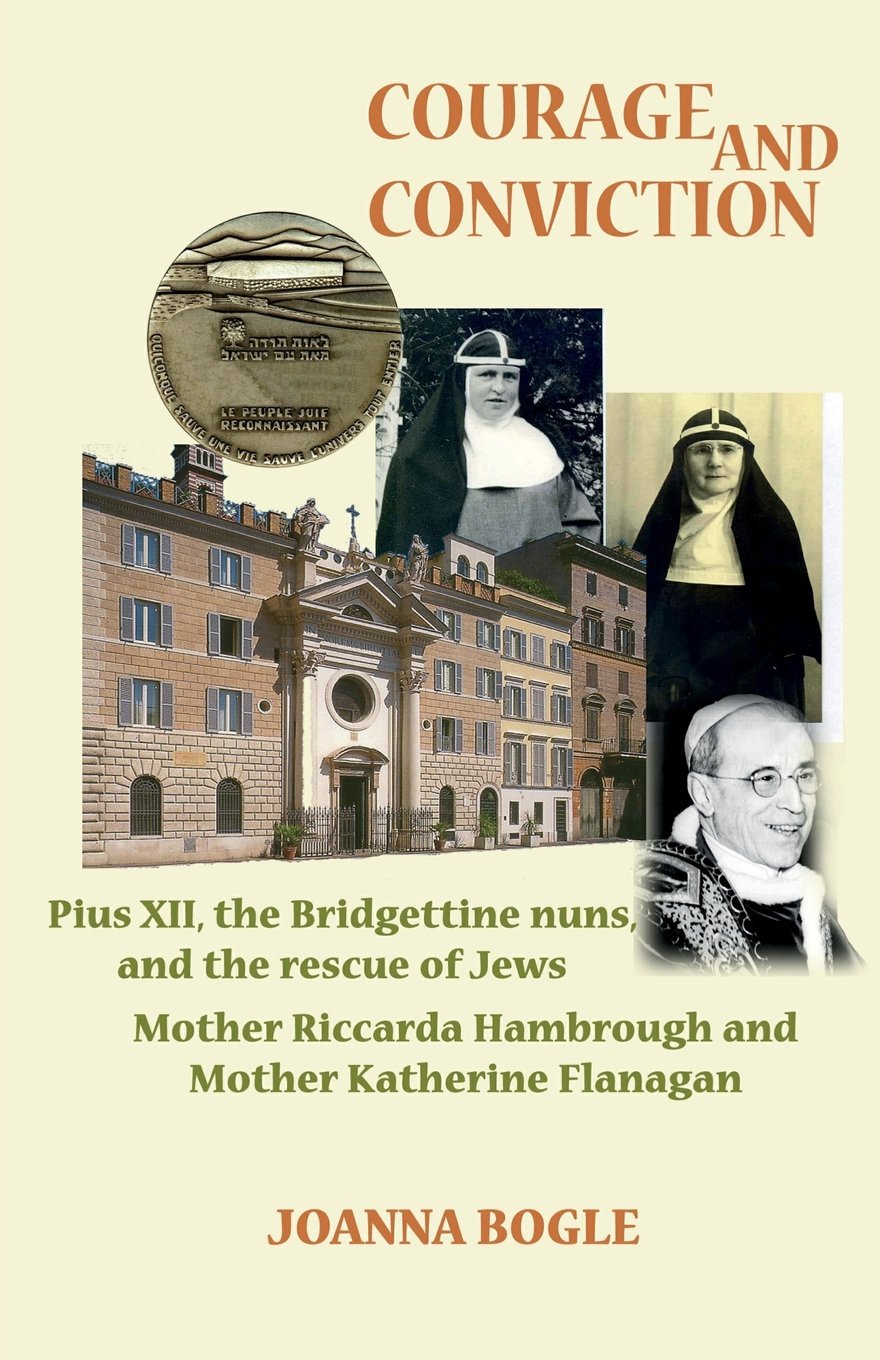
In a recent article published in The Catholic Herald, Dr Oddie began what looked to be a review of a new book by Joanna Bogle. However shortly after giving the reader a taste of what Bogle's book holds, and from what I have read by Oddie and Bogle, it looks like a book worth getting, Oddie launches into a a re-hash of many of the old chestnuts that apologists for Pius XII have used for decades.  Bogle's book concerns two English Bridgettine sisters who were active in rescuing Jews in Rome during the German occupation (September 1943-June 1944).  The story on its own looks to be a compelling one. It doesn't need to be turned into a propaganda item by those who wish to use any story of rescue for political ends.  I fear this is what Oddie has tried to do.

The insertion of a lengthy quote from David Dalin and recycling the long-debunked claims of Pinchas Lapide, lends aid to my fear that Oddie is more interested in keeping alive the dying flames of an old argument that most mainstream historians have long since walked away from.  The "vilifiers' of Pope Pius XII are not those who disagree with the ahistorical arguments of Dr Oddie and company, but rather the apologists themselves who dabble dangerously close to denialism and a reckless disregard for the truth.  It is Oddie and those who believe his version of events who insist on making the arguments for and against Pius XII a litmus test of Catholic orthodoxy.  Historians will keep on with the business of history.

Nonetheless, I look forward to reading Joanna Bogle's book.


Here is William Oddie's review:

Joanna Bogle has written prolifically and devotedly on a wide variety of subjects, always defending and proclaiming the values of the Catholic Church and aimed at nourishing in her readers the capacity to live the Catholic life; and her writings are undoubtedly an important part of what led recently to her deserved elevation to the rank of Dame of the Order of St Gregory. I have just read another of her books, shortly to be published by Gracewing, which everyone should read when it is published later this month: Courage and Conviction, the story of how two English Bridgettine sisters, Mother Riccarda Hambrough and Mother Katherine Flanagan, sheltered Jews in their convents during the German occupation of Rome. This account is invaluable, as a vivid insight into one small part of the much wider effort by religious houses and other Catholic institutions throughout Rome and the whole of Italy to shelter Jews from the Germans after the fall of Mussolini in 1943.

On the general question of Pius XII’s part in the shelter of Jews throughout Italy, Dame Joanna’s book is a useful guide, especially in the face of the persistent propaganda attempting to show that Pius XII was, to quote a particularly disgusting book title, “Hitler’s Pope”. As she points out, the majority of Italian Jews – some 80 percent – survived the Second World War, during the years when, across Europe 80 per cent of Jews died. She quotes J Lichten’s book [sic] A Question of Moral Judgement: Pius XII and the Jews,(1963) one among many accounts of what until recently was widely known and accepted by everyone (especially by leading Jews like Golda Meir), that “The Pope sent out the order that religious buildings were to give refuge to Jews, even at the price of great personal sacrifice on the part of their occupants; he released monasteries and convents from the cloister rule forbidding entry into these religious houses to all but a few specified outsiders, so that they could be used as hiding places. Thousands of Jews – the figures run from 4,000 to 7,000 – were hidden, fed, clothed, and bedded in the 180 known places of refuge in Vatican City, churches and basilicas, Church administrative buildings, and parish houses. Unknown numbers of Jews were sheltered in Castel Gandolfo, the site of the Pope’s summer residence [according to Rabbi David Dalin, at least 3,000 found refuge there], private homes, hospitals, and nursing institutions; and the Pope took personal responsibility for the care of the children of Jews deported from Italy.”

As Dame Joanna points out, the scale of the rescue operation was huge. In the City of Rome itself 155 convents and monasteries sheltered around 5,000 Jews. Sixty Jews lived for nine months at the Gregorian University, and a considerable number in the cellar of the Pontifical biblical institute. One could go on at wearying length.

The story of the English Bridgettines, Mother Riccarda Hambrough and Mother Katherine Flanagan, is one small and typically courageous part of the huge operation that Pius set under way. What emerges vividly is not only the vital part played by the Pope himself; but the indispensable part played by the faith and courage of so many individual Catholics who obeyed his call.

Mother Riccarda hid about 60 Italian Jews from the Nazis in her Rome convent, the Casa di Santa Brigida. She was baptised at St Mary Magdalene’s, Brighton, at the age of four after her parents converted to the Catholic faith. She was guided towards the Bridgettine Order by Fr Benedict Williamson, who was the parish priest of St Gregory’s Parish, Earlsfield, between 1909 and 1915. Sister Katherine Flanagan, too, was guided by Fr Williamson and also joined the Bridgettine sisters.

What is striking is the way in which, as far as possible, the Sisters made it possible for those they sheltered, not simply to cower in hiding, but to live normal and dignified lives. One refugee remembered that they had asked for refuge, but without saying at first they were Jews. They went to Mass, copying what the Catholics did. They were soon told that “we must live our own beliefs, that we should not feel any need to pretend, and that we must live and pray as Jews”. The same refugee told Dame Joanna last year (this book is not a scissors and paste job), that “I was even able to continue my education: a lady professor, a Jewish lady, came in and gave me lessons. She taught me Latin. We studied Tacitus and I became really engrossed in it. It was particularly important for me because earlier the Jews had been kicked out of all the schools, and I could have missed out on the chance of an education. But because of this tutoring, when the Allies arrived and we were liberated, I hadn’t missed a year of my schooling”.

The present Mother superior of St Birgitta’s, Mother Thekla, who knew Mother Riccarda well, remembers that she was “was truly very beautiful. She was a wonderful person — an angel on the earth. And she was humble—she had this spirit of service, of simply wanting to serve and help people”. This is an inspiring story, simply but powerfully told. “Above all”, remembers Mother Thekla, “[Mother Riccarda] had a profound respect for these Jewish guests. It was important not to let them feel humiliated by their situation—they were vulnerable, and it was crucial to let them know that they were welcome and that the sisters wanted to help them in any way they could.”

By concentrating on the Bridgettines in Rome, Dame Joanna has vividly brought to life a microcosm of what was happening wherever there was German occupation after the fall of Mussolini. Multiply this account by a thousand, and you have some idea of what the Catholic Church in Italy, directly inspired by the Pope himself, believed it had a vocation to accomplish.

By no means all Jewish writers today have uncritically accepted the torrent of anti-Pius propaganda, the contents of which over recent decades have generally been assumed by the secular media (and even by some Catholics) to be well-founded. As Rabbi David Dalin has written in a lengthy and important article, well worth reading carefully and in full, though Pius has had his defenders recently,

…. it is the books vilifying the pope that have received most of the attention, particularly         Hitler’s Pope, a widely reviewed volume marketed with the announcement that Pius XII was “the most dangerous churchman in modern history,” without whom “Hitler might never have . . . been able to press forward.” The “silence” of the pope is becoming more and more firmly established as settled opinion in the American media: “Pius XII’s elevation of Catholic self-interest over Catholic conscience was the lowest point in modern Catholic history,” the New York Times remarked, almost in passing, in a review last month of Carroll’s Constantine’s Sword.

Curiously, nearly everyone pressing this line today — from the ex-seminarians John Cornwell and Garry Wills to the ex-priest James Carroll — is a lapsed or angry Catholic. For Jewish leaders of a previous generation, the campaign against Pius XII would have been a source of shock. During and after the war, many well-known Jews – Albert Einstein, Golda Meir, Moshe Sharett, Rabbi Isaac Herzog, and innumerable others —publicly expressed their gratitude to Pius. In his 1967 book Three Popes and the Jews, the diplomat Pinchas Lapide (who served as Israeli consul in Milan and interviewed Italian Holocaust survivors) declared Pius XII “was instrumental in saving at least 700,000, but probably as many as 860,00 Jews from certain death at Nazi hands.” 

In the end, that truth will once again become generally accepted. When it is, Joanna Bogle’s important new book will have played its part.


Saturday, July 7, 2012

Robert Ventresca points to the complexities surrounding Pius

I have referred to Professor Robert Ventresca of University of Western Ontario in a previous post.  His work on Pius XII is balanced, critical and highly nuanced.  This interview came from Charles Lewis of the Canadian National Post.  Ventresca makes several highly significant points about context, points that have been argued on this blog since its inception.  I commend the interview.


Taking another look at Pope Pius XII's 
actions during the Holocaust


Charles Lewis, July 6, 2012


Pope Pius XII reigned between 1939 to 1958, a period of catastrophic events. But history seems mainly concerned about his behaviour around the Holocaust. Pius has been accused of being a German sympathizer or at best failing to do his moral duty to help save the Jews of Europe by keeping silent. For others he was a saint who used his skill as a diplomat to save thousands of Jews from Nazi terror. But this week in Jerusalem, Yad Vashem, the world’s most foremost Holocaust museum, softened its criticism of the wartime pope, allowing that despite faults he did help save Jewish lives. The changes in an exhibit on the pope seem subtle, but given the divisions between Roman Catholics and Jews over Pius’ actions, even small changes are considered important. For example, Yad Vashem now acknowledges the 1942 Christmas radio message in which Pius speaks of “the hundreds of thousands of persons who, without any fault of their own, sometimes only because of their nationality or ethnic origin, have been consigned to death or to a slow decline because of their ethnicity.” The National Post’s Charles Lewis spoke to Robert Ventresca, a professor of history at King’s University College at University of Western Ontario in London, Ont., who is completing a biography of Pius XII called Soldier of Christ.

NP: What does the Yad Vashem decision signify?

RV:
 This rewording constitutes a minor diplomatic victory for the Vatican and the defenders of Pius XII insofar as it seems to correct what was considered to be the decidedly one-sided and inaccurate original description. I think that it’s unfortunate that this decision has sparked the predictable range of polarized opinion — such as saying the exhibit now vindicates Pius. I do think the new wording is remarkably balanced and nuanced not just about Pius but of the Church in general. It conveys clearly there is a range of opinion on this subject.

NP: When Pius died in 1958, he was widely praised by Jewish leaders, including Golda Meir, later Israeli prime minister. Then came Rolf Hochhuth’s 1963 play The Deputy, which vilifies Pius and started the decline in his reputation. Did anyone question his role before?

RV:
 There was a clear and consistent criticism of his policies, and especially of his diplomatic style and choices, beginning as early as 1939 and continuing through the war years and beyond. It’s important to stress that some of the strongest and most consistent criticism came from within the Catholic world. The lines of the debate have remained fairly constant over the years but intensified after The Deputy. There was the feeling that Pius as the Vicar of Christ was expected to raise his voice in protest. Even after the war, there were Catholics who wanted him to say something explicitly about what had happened to the Jews. The matter always comes back to the nagging doubts about what felt to many like excessive papal caution in the face of unspeakable atrocities.

NP: Was the Jewish leaders’ praise misguided?

RV:
 It was not so much misguided, as only partly informed, especially considering that when he died in 1958 the historical understanding about the Holocaust was in its early stages. It’s a matter of record that in the months after the war Jewish delegations went to Rome to thank the pope for what the Church had done on their behalf. But as we learned more about the Holocaust, it allowed us to approach the story of rescue with a greater degree of differentiation among the various layers of the Church. In effect, the pope’s indirect role in these efforts has receded into the background, while the courageous efforts of the Catholic rescuers on the ground have moved to the forefront.

NP: For most people Pius is either a saint or the worst sinner. What’s wrong with that analysis?

RV:
 The problem arises from the tendency to think of Pius XII the way he was presented in The Deputy — as “less a person than an institution.” Thinking of Pius XII that way works only if your intention is to render the man a myth, which can never correspond to the more complex reality of a man who struggled, often unsuccessfully, to reconcile his very human attributes and foibles with the demands of leading a global community whose self-ascribed nature and mission were not of this world. When we approach Pius XII as a person, we find a man of considerable talent, intelligence and imagination, who nonetheless often could not free himself from the norms and conventions of his upbringing and clerical training to grasp fully how the times in which he was living required an extraordinary courage and originality.

NP: So how do you see him after all your research?

RV:
 There are things about him that are so admirable, but other things at the end of the day that leave me ambivalent. There was an intelligence, an unmistakable spirituality, a keen mind at work. At the same time, he could be very narrow-minded and unyielding. [In terms of the Holocaust during and after] he could be excessively diplomatic rather than evangelical in his criticism. After the war he didn’t appear to want to come to terms with what happened and did not want broach the important question of the role of historical Christian anti-Semitism in leading to the Holocaust.

NP: Was he an anti-Semite?

RV:
 Much of what we say about Pius and the Jews has to be inferred. There is nothing I recall seeing in the way of a letter or an encyclical or speech that tells us much about what he thought about Jews and Judaism. He was a man of his times. He would have had an appreciation of the Jewish roots of Christianity and a great love of the biblical heritage of Judaism. But there would have been a certain measure of ambivalence, especially of Jews in the social and economic life of European societies. I don’t think he had any special appreciation of sense of duty toward contemporary Jews or Judaism. But he was not indifferent to Jewish suffering. He would have seen the suffering Jews as akin to the suffering of many others who were suffering as a result of destructive modern ideologies, including communism.

NP: What did he think of Nazis?

RV:
 I think he saw Nazism as a kind of heresy. He saw the nationalism and the racial theories incompatible with Christian teaching.

NP: Why couldn’t he have said just once directly the actions against the Jews were wrong and no Catholic should be a party to them?

RV:
 That’s the nagging question. There was always this vague allusion to people who were targeted for no reason other than their ethnicity. After the war, for instance, he spoke directly about the persecuted clergy of Poland and the sad fate of German youth, but there is no explicit mention of what happened to the Jews. There it is. When we come back to the question of his relations to Jews, there remains many nagging questions. One of the problems I have with the certain defenders is that they don’t want to deal with the uncomfortable questions.

NP: But did he save Jews?

RV:
 There are some exaggerated claims made by certain defenders that Pius XII helped to rescued tens if not hundreds of thousands of European Jews, albeit indirectly through the work of papal institutions or other Catholic organizations and religious orders. These claims are not tenable in my view, nor especially instructive, since they would credit the pope with efforts that took place often without his specific knowledge, approval or encouragement This is not to say that his general policy, as well as the work of certain Vatican-related institutions in Rome itself with the Pope’s approval, did not help to save lives. Clearly, Pius XII knew of and approved of initiatives by his representatives or other Catholic individuals and institutions in Italy and parts of Europe to rescue Jews and other civilians. Near the war’s end, the Vatican itself boasted of having helped to save at least 6,000 Jews in Rome alone during the Nazi occupation. Some scholars put that number at closer to 4,000.
Then there is the case of high-level papal intervention with leaders in Hungary and Slovakia during the war to prevent the deportation en masse of tens of thousands of Jews. In the end, the Pope’s intervention was only partly successful, but undoubtedly his direct intervention helped to save lives, though it is difficult to say with great precision just how many.


Saturday, June 25, 2011

Mordechay Lewy on Pius XII

The big news this week are the comments made by the Israeli ambassador to the Holy See, Mordechay Lewy.  The ambassador's comments have, according to several news agencies, "added to the controversy" over Pius XII and his actions or inactions during World War II.  I took this copy of the text from Speroforum.  The article also includes a link to YouTube clip from Rome Reports.  Some of Lewy's comments are recorded there.  Curiously, Lewy makes no mention of Pius XII.

So, what does the ambassador say?

Apparently breaking with a taboo among critics of the Catholic Church and of Pope Pius XII – who reigned during the Second World War and the Holocaust – Israel’s ambassador to the Vatican has recognized that the pontiff did actually save thousands of Jews during the years of Nazi predation.  An opening paragraph such as this one sets up what has become the classic "straw man" in populist Pius XII circles - the presumption that history is black and white, and that the Pope did nothing.  It is too easy, simplistic and makes a nonsense of what historians do.  It does, however, "hook" the reader.


Ambassador Mordechai Lewy affirmed on June 23 that “as of the raid of 16 October 1943 and the days following in the ghetto of Rome, the monasteries and orphanages of the religious orders opened their doors to Jews, and we have reason to believe that this occurred under the supervision of the highest authorities of the Vatican, who were aware of these measures.” The diplomat spoke at a ceremony in which a Catholic priest, Gaetano Piccinini of the order founded by Don Orione, was post-humously.

The language is important.  Lewy is an ambassador, not an historian.  While his general sweep of historical understanding is largely accurate, it is, as always, in the details, that the most significant things are found. 

Rome's religious houses had been offering shelter to Jews since the 8 September armistice and the German occupation of Rome in the days following.  Much ink has been spilt on whether this action came as a direct papal intervention or not.  Lewy is careful, as all diplomats are, and hedges his praise of the Vatican in very general language that can be interpreted a number of ways.  Re-read the blue highlighted sentence.  This is a statement that suggests there is more to be realised than what we know at present.  The work of Salesian sister, Grazia Loparco on the rescue of Jews by religious orders and congregations is a major research project that is helping fill in details about the "hows, whens. wheres and whys" of rescue.  She has found no concrete evidence of a papal order.

It is well-known that many religious houses used the presumed authority of the Pope to open doors and give shelter to Jews.  We also know that Pius knew, approved and encouraged such actions.  We know that hundreds of Jews were given shelter at the Papal summer villa at Castel Gandolfo with explicit papal consent. 

Did Pius give an order?  I think it is the wrong question to ask.  More historically accurate is the presumption that when the situation for the Jews of Rome became precarious, Pius quietly endorsed any and all rescue efforts - and most of these were already in progress.  I do not believe any order was given.  Firstly, there was no need.  The evidence is overwhelming, Italian Catholics rescued and sheltered Italian Jews and non-Italian Jews.  Secondly, as Sr Margherita Marchione assured me some years ago, the Pope would not have commited anything to writing lest it put rescuers in danger.  And since a German invasion of the Vatican was considered a real enough threat throughout late 1943 and up to the moment of liberation in June 1944, it would defy sense and everything we know about the diplomatic instincts of Pius to even think he would give such an order. 

There may be material in the Archivo Segreto Vaticano that says otherwise, but, quite frankly, I doubt it.  ADSS has nothing along these lines, and I find it hard to think they would have omitted what would have been a document of major importance.  There is not written papal order and I do not think there was even an explicit verbal order.  There was no need.

Media reports in Italy claim that it was Pope Pius XII, who is largely dismissed as having done little to save the victims of the Holocaust, who transmitted an appeal to religious orders through his Secretary of State, Cardinal Luigi Maglione. The pontiff’s desire that the Jews of Rome be sheltered from the Nazi storm was transmitted in conversations and messages so as to avoid Nazi reprisals. Besides the approximately 5,000 Jews who took refuge in Rome’s convents, schools, and monasteries, several thousands more were sheltered at the papal villa at Castelgandolfo in Rome.

This is a very broad assertion and one that creates difficulties.  ADSS 9.368, records the meetings between Maglione and German ambassador, von Weizsacker.  What ever description may be used to describe the encounter, "protest" at the treatment of the Rome Jews, is not one I would use. 

Pius was determined to avoid any public act that would damage Vatican neutrality.  Without access to the ASV material that could shed more light on this, the best interpretation I can give is the desire of the Pope to remain publically outside all engagement to do with the roundup of Rome's Jews so that the rescue and refuge work going on would not be damaged.  It is true that nearly 5000 Jews were hidden across Rome in religious houses and more at Castel Gandolfo.  I also stress here that these acts of rescue, many done in the name of the pope, should and must be noted.  It is the antidote to the mantra that "he did nothing"; Pius did act.  The questions remain though, how much did he do, and what were the possibilities for greater action?  And it is also important to bear in mind that the focus here is Rome.

Ambassador Lewy said “the fact that the Vatican could not prevent the departure of the train that took the captives from Rome to the extermination camps can only have contributed to reinforcing the desire, on the part of the Vatican, to offer its own premises as a refuge for Jews.” In any event, continued the diplomat, “we must recognize that the train that left on 18 October 1943 was the only convoy that the Nazis managed to organize in Rome for Auschwitz.”

All this is true, except for the need to recognise the "behind the scenes" activity undertaken by members of the German embassy and Vatican "go-betweens" including the Pope's nephew, Carlo Pacelli.  What stands out is the fact that the Germans believed Pius would definitely speak out if the Rome Jews were deported.  Weizsacker made that clear to Berlin.  The concern that the Pope would speak was sufficient for Himmler to apply the brakes to the raids in Rome (not elsewhere). 

Could the Jews held in the Collegio Militare have been rescued?  History deals with "what was", not "what ifs".  Based on the available historical records it is difficult to say.  Once in German hands, captured Jews were caught and the reality was that few, if any, were allowed to leave.  The attitude of Rome's Jews remained positive that the Pope would protect them.  All the activity of the Vatican "middle men", the German embassy staffers and others came to naught.  The SS were not about to let their prizes be snatched away.  The ambassador's statement that the 18 October 1943 transport was the only German one to leave Rome is true. I think that Pius knew, based on over two and a half years of reports on the fate of Europe's Jews, that those incarcerated next to the walls of the Vatican, would not be released. 

It is tantalising to wonder what may have happened had the Pope gone and stood outside the gates and demanded their release ... but that is a "what if".  We do know that when Rome was badly bombed in July 1943 Pius acted immediately and went to the worst hit part of the city to offer what comfort he could.  It makes a "what if" about Rome's Jews even harder to resist.

In view of these facts, Ambassador Lewy affirmed that “it would be a mistake to say that the Catholic Church, the Vatican or the Pope himself were opposed to activities to save Jews. It is quite certain that it was to the contrary: they always gave the help that they could.”

I agree.  There was no opposition to help rescue efforts - it is utter nonsense to suggest otherwise.  But, let us keep the perspective.  Rome and Italy were the two places where the Pope had serious "clout" and it is also important to remember that the full force of German brutality only began after September 1943 and lasted in Rome for nine months.  It is a very different reality to those who engaged in rescue in Poland, Ukraine etc where the German terror lasted for years.

Some historians, despite contrary claims made by writers such as John Cornwell, argue that it was the Catholic Church that saved more Jews than any other institution during the Second World War and the Holocaust. Historian Pinchas Lapide, an Israeli consul to Italy in the 1960s, claimed that this number may amount to 750,000. Renowned British historian Sir Martin Gilbert, who has written about righteous Gentiles who gave their lives to save Jews, has also praised the work of Pope Pius XII.

If in doubt, drag out Lapide!  My comments on Lapide's very rubbery figures appear in another entry on this blog.  Suffice to say here, that this paragraph could or should just be erased.

The Jewish Virtual Library, a website dedicated to the history and culture of the Jewish people, wrote however of the wartime pope, “Pope Pius XII's (1876-1958) actions during the Holocaust remain controversial. For much of the war, he maintained a public front of indifference and remained silent while German atrocities were committed. He refused pleas for help on the grounds of neutrality, while making statements condemning injustices in general. Privately, he sheltered a small number of Jews and spoke to a few select officials, encouraging them to help the Jews.”

Quod scriptum est!  What is written, is written.  The JVL is an online encyclopedia with brief articles that, hopefully, lead the reader to explore more deeply.  I tell my students to go beyond encyclopedias in their research.  Go and find the texts and the detailed studies.  In any case, the overall tenor of the JVL article is sound.

Pope Pius XII did receive thanks during his lifetime for his actions to save Jews. At the end of the Second World War, Chief Rabbi Israel Zolli of Rome entered the Catholic Church and took the name Eugenio in homage to the Pope whose baptismal name was Eugenio. In addition, a wealthy Italian senator and member of Italy’s Jewish community presented the pope with a luxurious villa in the center of Rome that still serves as the Vatican’s nunciature in the Italian Republic.

None of this adds to the thurst of the article.  Israel Zolli's history remains very controversial, to use an over used word.  He is still preceived as a renegade by many Italian Jews and others.  The questions about his disappearance just before the German raid on the Rome community remain unanswered to any degree of satisfaction.

Golda Meir, who would go on to become a prime minister, spoke as Israel’s foreign minister in 1958 and praised Pope Pius XII following his death. Speaking on behalf of her government, the US-born Meir said that “during the ten years of Nazi terror, when our people suffered the horrors of martyrdom, the Pope raised his voice in condemnation of the oppressors and to lift up the victims.” While the pope had spoken generally against the extermination of human beings, his critics still maintain that he could have done more.

I find the term "critics" rather harsh in this context.  It is easy to posit those who have questions about the Pope's role as "critics" when placed beside the praises given by Golda Meir.  What is not noted is that serious Holocaust scholarship was barely in its infancy, the study of the Vatican's role/s during the early 20th century and its all too easy cohabitation with the regimes of the right had not begun, and the study of the war years was still only moving past individual countries and generals writing about their glorious achievements.  Meir's words are moving, but the historian must continue to place them into their appropriate context.

But, hang on a minute!  The main point of there being an article at all was to mark the presentation of the honour of Righteous Among the Nations in memory of Father Gaetano Piccinini (1904-1972), a priest in Rome who rescued Jews.  That event should be celebrated for the great moment that it was and is.


 Fr Gaetano Piccinini, Righteous Among the Nations.